Today we have a special guest post from Dawn (aka DJMinNL), a postcrosser who lives in the Netherlands but was born in Scotland. She recently wrote to us with a wonderfully quirky piece of postal history: the time when Scottish pillar boxes became the unlikely stars of a national “stooshie”. If you’ve ever looked twice at the lettering or symbols on a postbox, you’re going to enjoy this one!
The Scottish Pillar Box War was one of those odd moments in postal history when something as ordinary as a post box ended up at the centre of a national debate. Despite its dramatic name, it was never a real “war.” It was more of a stooshie (a good Scots word for an uproar) involving red pillar boxes, royal lettering, and a question of historical pride.
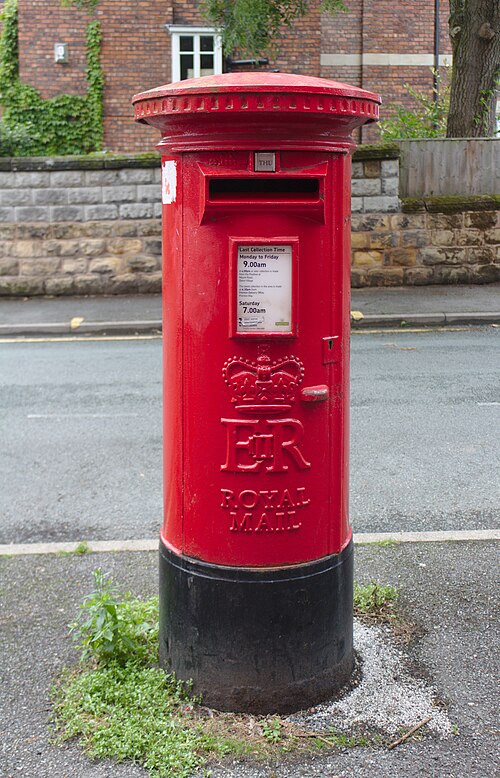
A Queen Elizabeth II Type A pillar box on Wellington Road, Birkenhead. Shared by Rodhullandemu on Wikipedia.
The story began in 1952 when Elizabeth II became queen. When she chose “Elizabeth II” as her regnal number, it seemed perfectly logical in England: she was the second monarch with that name after Elizabeth I, who ruled from 1558 to 1603.
But there was a small historical wrinkle. Elizabeth I ruled England and Ireland before the crowns of England and Scotland were united in 1603. Scotland, therefore, had never had a Queen Elizabeth I. For some Scots, calling the new monarch “Elizabeth II” felt like England’s numbering system was imposed on them despite the historical facts.
Royal Cypher of Elizabeth II of the United Kingdom
Now, constitutional debates don’t usually involve everyday street furniture. However, the new red pillar boxes operated by the Royal Mail carried the royal cypher “E II R” short for Elizabeth II Regina (“Regina” meaning queen in Latin). Suddenly, those elegant raised letters on brand-new boxes became a visible reminder of the disputed “II.”
For a small number of annoyed Scots, the solution was simple: remove the “II.” Some pillar boxes had the number scratched out or hammered flat. Others were painted over. A few suffered more dramatic treatment—one or two were even damaged with small explosives. These incidents were rare but colourful enough to attract newspaper headlines, and the whole episode soon picked up its memorable nickname: the “Scottish Pillar Box War.”
Most of the activity took place between 1952 and 1953, particularly in Glasgow and Edinburgh. The “attacks” were usually carried out quietly at night by individuals or small groups rather than crowds. One pillar box in Edinburgh became particularly notorious, it was repeatedly defaced by tar, paint, and a hammer before finally being blown to pieces less than three months after it was installed.
From a postal perspective, the damage was inconvenient but hardly catastrophic. Still, it was enough to persuade authorities that perhaps a small design adjustment would make life easier for everyone.
Post-1954 pattern Royal Mail lamp post box of the type used in Scotland, showing the Crown of Scotland. Shared by Rab-k on Wikipedia.
A practical compromise soon followed. Instead of displaying the queen’s cypher, new pillar boxes installed in Scotland would simply show the Crown of Scotland. The change neatly avoided the disputed numbering while keeping a royal symbol on the box. After that, the vandalism quickly faded and the pillar boxes quietly returned to doing what they do best—collecting letters.
Interestingly, the design choice stuck. Even today, the Scottish pillar boxes continue to display the Scottish crown rather than a monarch’s cypher. When Charles III came to the throne in 2023, it was announced that Scottish boxes would keep the crown rather than adopt the new “C III R” lettering.
This episode is a reminder that post boxes are more than just practical street furniture. Their designs, ciphers, and symbols can reflect politics, identity, and sometimes a surprising amount of local feeling, for example, when Ireland gained its independence they painted the old red post boxes green.
And it raises an interesting question for Postcrossers: has there ever been similar controversies about post boxes or postal symbols in your country?
For anyone curious, the uproar even inspired a song. The lyrics to “Sky-High Joe”—a humorous take on the whole affair—can still be found online.
A fitting legacy for a dispute where, for a brief moment, the humble pillar box found itself at the centre of national attention.
I am going to Scotland in June and can't wait to find these post boxes around the country and see if I can find these modifications and see the Crown of Scotland. I love these bits of history and the word "Stooshie". I'm going to have to find a way to incorporate this into a letter or postcard soon. It's fun to say and write!
For me this is the best part of history in American Postal Services.
The Pony Express was a fast, 1,966-mile mail relay service operating between Missouri and California from April 1860 to October 1861. Using roughly 80 riders and 400 horses, it carried mail in 10 days, cutting travel time in half. It was rendered obsolete by the transcontinental telegraph after 18 months.
Thank you for sharing this beautiful story. I love it and I will no longer see the mailboxes in England, or Scotland in the same way;D
In France, when there are disputes in a village or between small groups, we call it 'a church feud', with you it’s a feud of mailboxes:D
What a delightful read and a bit of postal history I didn't know about. I live in the U.S., but when I was in London last fall, I visited the Royal Postal Museum. I don't recall seeing anything about this. Will definitely be sharing it with my readers who love almost anything epistolary!
Interesting. We have those red post-boxes here too. I just took a photo of one in the downtown area last week. It has a crown with the letters GR beneath it.
I love the word “stooshie”, so want to adopt using that. I loved reading this article, thank you for sharing, love a good postal story. Here in Australia, we have a citizen gaining recognition for refurbishing colonial-era postboxes — known as pillar boxes. Hopefully this link will open for all to see ? https://www.abc.net.au/news/2026-01-18/vic-letterbox-man-s-colourful-hobby/106169390 I think there is videos on You Tube and TiKTok too of his work, Mick Slocum is his name. I just love his period costume while taking the time to make posting an item a little bit more special for the locals. Lucky people of Ballarat and Melbourne.
Living and learning, people say.
Being a postcrosser and learning, I would say.
Post boxes have hidden political power, who could imagine that. In Brazil, so far that I know, these lovely pieces had no particular role, but... maybe ther is something to be discovered.
Love this post, really, thanks for coming up with these details.
Fantastic artical about the red boxes who will disappear soon . In India we heard number of such red boxes will be reduced soon. letters travelling by post number has dropped substantially so there is no need of such red boxes. However
I would like to know about any dispute or war 😀about the cancellation marks or postal stationary of EIIR in Scotland Post during that era.
I had a box of postcards picturing Scottish remote postboxes photographed by Martin Parr. The postcard box issue came together with the book. But ofcourse as a postcrosser I bought the cards only!
This is how it looks like
https://www.deslegte.com/martin-parr-remote-scottish-postboxes-2194195/
In Hong Kong there are some ERII postboxes but we don't really feel offended even our city was never under the rule of ERI.On the other hand, we considered these postboxes more a mark that our city was once a British colony.

.jpg "ER2 royal cypher")
.jpg "Royal Mail Lamp Box (Scotland)")
.jpg "ER2 royal cypher")
.jpg "Royal Mail Lamp Box (Scotland)")

.jpg)
35 comments so far
So delighted to see the word ‘stooshie’ in a Postcrossing blog! Loved reading this 💙🏴
wow - i'm from scotland and didn't know this piece of history. good read.
I am going to Scotland in June and can't wait to find these post boxes around the country and see if I can find these modifications and see the Crown of Scotland. I love these bits of history and the word "Stooshie". I'm going to have to find a way to incorporate this into a letter or postcard soon. It's fun to say and write!
How interesting! I wish I'd noticed the pillar boxes during my decade in Berwick-On-Tweed (Fairly close to Scotland :-))
Interesting article! And I learned a new Scottish word - "stooshie"! 😊
Great fun. Nice song.
For me this is the best part of history in American Postal Services.
The Pony Express was a fast, 1,966-mile mail relay service operating between Missouri and California from April 1860 to October 1861. Using roughly 80 riders and 400 horses, it carried mail in 10 days, cutting travel time in half. It was rendered obsolete by the transcontinental telegraph after 18 months.
Thank you for sharing this beautiful story. I love it and I will no longer see the mailboxes in England, or Scotland in the same way;D
In France, when there are disputes in a village or between small groups, we call it 'a church feud', with you it’s a feud of mailboxes:D
What a fun story! I do love the look of the red pillars. It always inspires me to send more postcards.
Great story. I know when we visited we saw some quite old post boxes, that predates EIIR. Can't remember where though.
Thanks for the interesting post!
I love Scotland!
I will pay special attention to the post boxes while in Edinburgh!
Thank you for sharing this I laughed really hard I used to work for the Post Office in the US so I really enjoy postal stories
What a delightful read and a bit of postal history I didn't know about. I live in the U.S., but when I was in London last fall, I visited the Royal Postal Museum. I don't recall seeing anything about this. Will definitely be sharing it with my readers who love almost anything epistolary!
What a lovely postal story.
No photo of the “defaced” postbox?
Interesting. We have those red post-boxes here too. I just took a photo of one in the downtown area last week. It has a crown with the letters GR beneath it.
"...and the pillar boxes quietly returned to doing what they do best—collecting letters." AND POSTCARDS!!! :-)))
Scotland, my favourite country. <3
I love the word “stooshie”, so want to adopt using that. I loved reading this article, thank you for sharing, love a good postal story. Here in Australia, we have a citizen gaining recognition for refurbishing colonial-era postboxes — known as pillar boxes. Hopefully this link will open for all to see ? https://www.abc.net.au/news/2026-01-18/vic-letterbox-man-s-colourful-hobby/106169390 I think there is videos on You Tube and TiKTok too of his work, Mick Slocum is his name. I just love his period costume while taking the time to make posting an item a little bit more special for the locals. Lucky people of Ballarat and Melbourne.
Living and learning, people say.
Being a postcrosser and learning, I would say.
Post boxes have hidden political power, who could imagine that. In Brazil, so far that I know, these lovely pieces had no particular role, but... maybe ther is something to be discovered.
Love this post, really, thanks for coming up with these details.
Thank you for sharing! I hope one day I visit Scotland and see the post boxes.
Yep, us Scot’s will have none of it! We know what we want 🏴🏴🏴🏴
Great story - Thank you for sharing this interesting history.
❤️❤️❤️❤️
Fantastic artical about the red boxes who will disappear soon . In India we heard number of such red boxes will be reduced soon. letters travelling by post number has dropped substantially so there is no need of such red boxes. However
I would like to know about any dispute or war 😀about the cancellation marks or postal stationary of EIIR in Scotland Post during that era.
Dank je wel Dawn voor je verhaal.
Thank you Dawn for your story.
Very interesting, thank you for sharing!
Nice block, good read!
I had a box of postcards picturing Scottish remote postboxes photographed by Martin Parr. The postcard box issue came together with the book. But ofcourse as a postcrosser I bought the cards only!
This is how it looks like
https://www.deslegte.com/martin-parr-remote-scottish-postboxes-2194195/
In Hong Kong there are some ERII postboxes but we don't really feel offended even our city was never under the rule of ERI.On the other hand, we considered these postboxes more a mark that our city was once a British colony.
What a stooshie, indeed! And I'm happy to have learned a new word today!
Interesting bit of stooshie!
love when people stand on their rights and needs, inspiring article <3
Thanks for the story
Very interesting to know that story
Interesting story! Loved it.
How interesting, I did not know this. I'll look at our crown postboxes with renewed interest from now on!
↑ Back to top ↑