Postcrossing Blog

Stories about the Postcrossing community and the postal world

Viewing posts tagged "uk" View all

  Posted on

David (aka DrHyde) from London has a knack for finding just the right postcard or stamp for every recipient. He’s also a cricket umpire and has started a very funny postcard tradition that might just go on forever… Let’s meet him in this week’s spotlight!

How did you get started sending postcards? What is your earliest memory of them?

Back in the good old days everyone sent postcards when they went on holiday, and my family was no different. These days I still send postcards when on holiday, although in some places it’s getting harder to find tourist cards.

How did you come across Postcrossing? What got you hooked?

I play Go, an Oriental strategy game, and in early August 2017 I travelled to a tournament on the Isle of Man. The tradition of sending postcards to family members is so deeply-rooted that it’s almost a compulsion now, but I was surprised that I just couldn’t find any cards that showed the very pretty village I was staying in. The only cards I could find were for the TT motorcycle races, which don’t even go through that village!

I mentioned this to another player at the tournament and the conversation meandered around a bit but he mentioned Postcrossing, I thought it sounded interesting, and I sent my first card shortly after returning home. I thought I’d give it a go for a bit and see what happened, and just fell in love with all the strange places that cards went to and from.

What is your favourite part of the Postcrossing process?

Early on I most looked forward to receiving cards from new places. It’s been a few years now so I don’t get many new places, although they do still appear occasionally. My most recent strange places were card AE-38540 from the UAE, and AR-28414 from Ushuaia, the closest place you can get to Antarctica without getting your feet wet.

A postcard showing the port of Ushuaia, with snowy mountains on the background

These days I enjoy more sending cards, trying to match a card to a random stranger’s profile. I sent GB-1918737 to a gentleman whose profile said he is into ships and tools, so that card shows some of the tools that were custom-made for the construction of a replica of a 7th century ship, and I sent GB-1918735 to a lady who volunteers for her church and likes religious cards.

I also try to match stamps to peoples’ profiles. Here in the UK we are blessed with a vast number of special stamps on all kinds of themes. Some stamp collectors complain that they are “extruded philatelic product” whose purpose is to make money instead of being paragons of the art of stamps. I agree, they are a blatant commercial wheeze. But I’m not a collector, I want to use the stamps, and so that vast variety is just what I want.

I always keep some Harry Potter stamps in stock because so many people are fans. I also always have lots of stamps showing wildlife and plants. And a couple of weeks ago, sending a card to someone called James, I just felt compelled to use this stamp!
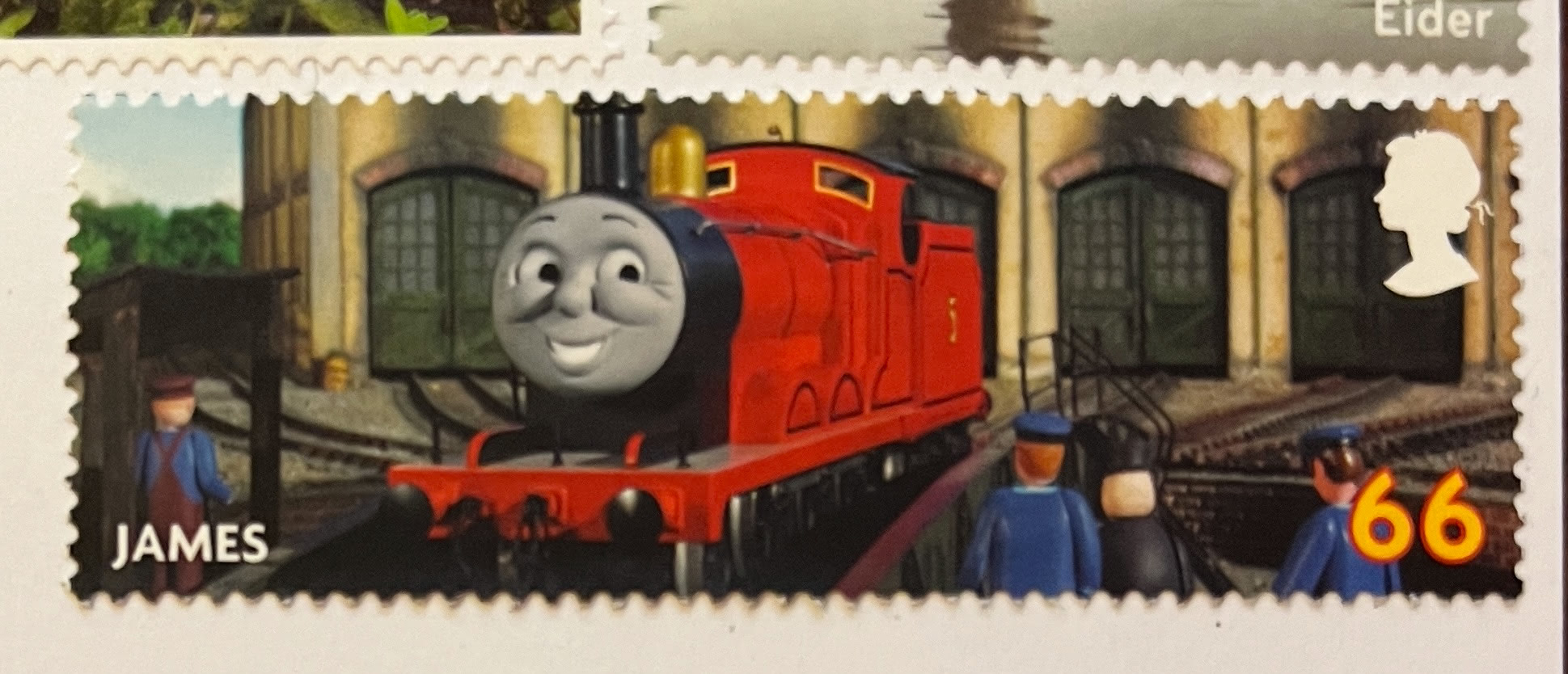
A British postage stamp that David chose especially for a Postcrossing recipient named James.
Have you been surprised by any place that you have received a postcard from or sent a postcard to?

Given how well-connected the whole world is now I kinda expect to exchange cards with people all over the place. The biggest surprise has been how few I’ve exchanged with people in Africa. I’ve received just one official card from South Africa and one from Tunisia, out of almost 1500 cards total.

Show and tell us about your favourite received postcard to date, and what makes it special.

One of the things I ask for on my profile is recycled product packaging. My absolute favourite “postcard” of all time is US-8313703, made from a takeaway pizza box.

A handmade postcard created from recycled takeaway pizza box packaging, sent to David through Postcrossing.
Show us your mailbox, your mailman/mailwoman, your post office or the place where you post or keep your postcards!

A few years ago I took a selfie of me about to post some cards, to illustrate a post on Mastodon where I was talking about Postcrossing. Then I realised that Postcrossing people often like postal-themed cards, so I turned that photograph into a postcard.
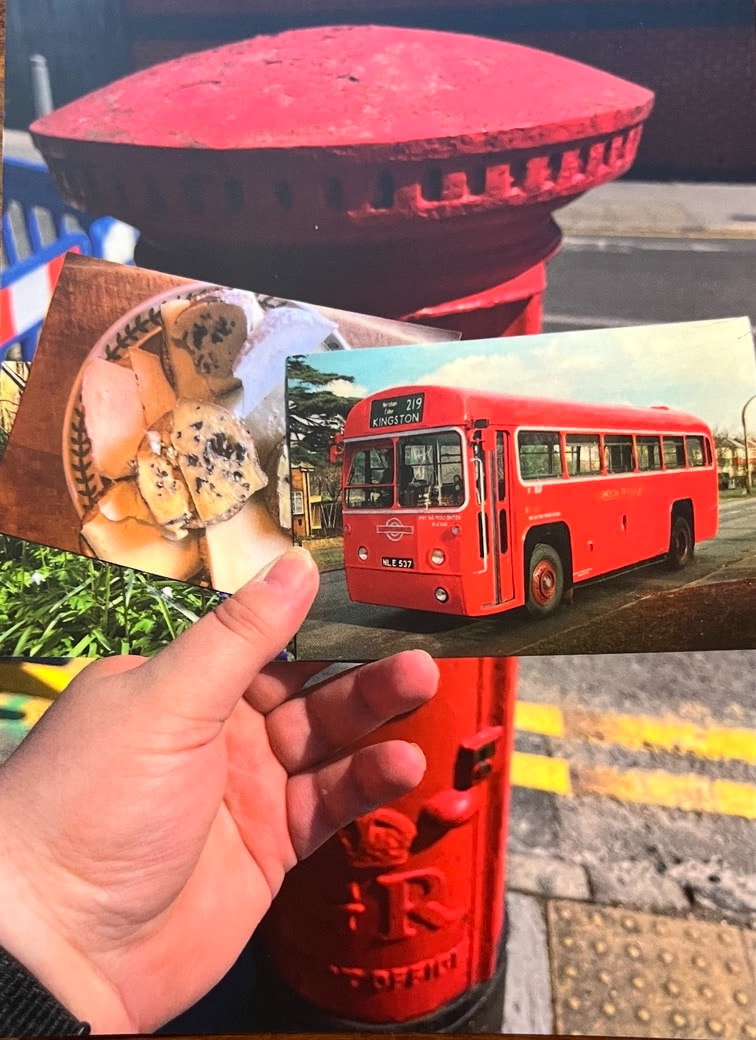
David taking a selfie while preparing to post postcards, a photograph he later turned into a postcard of its own.

Of course, I had to take a photograph of me posting that card too, and that photograph in turn got turned into a postcard.
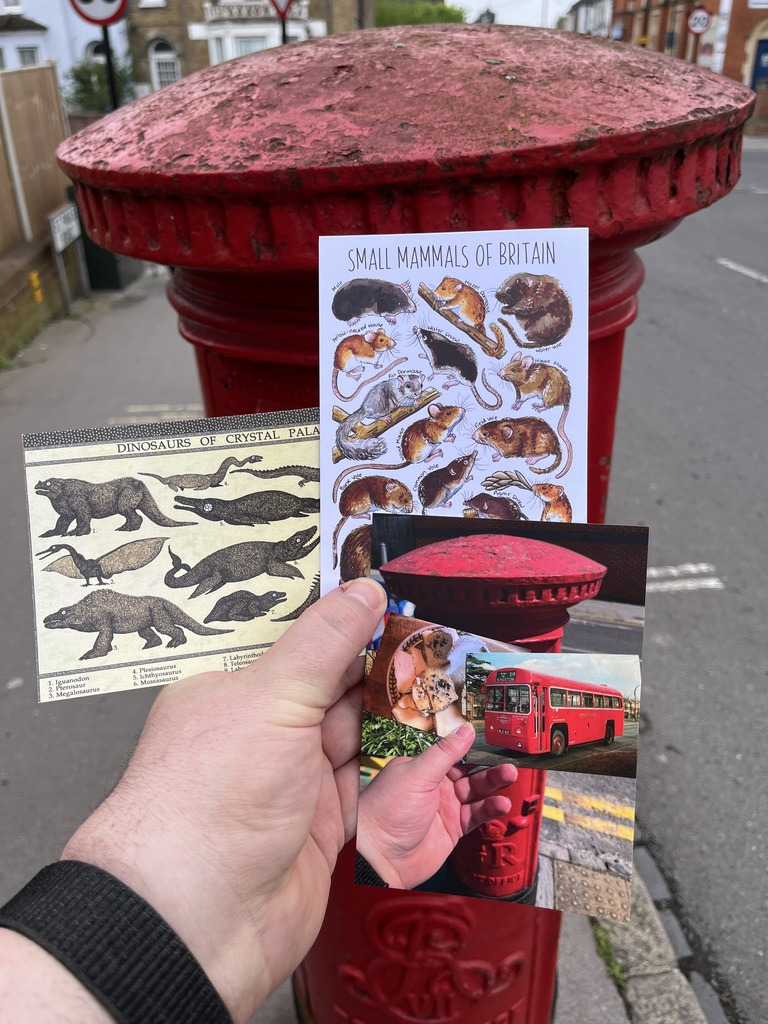
David posting a postcard featuring the earlier photograph of himself preparing to mail postcards.

And I’m going to continue this silly game FOR EVER! The next one in the series is:
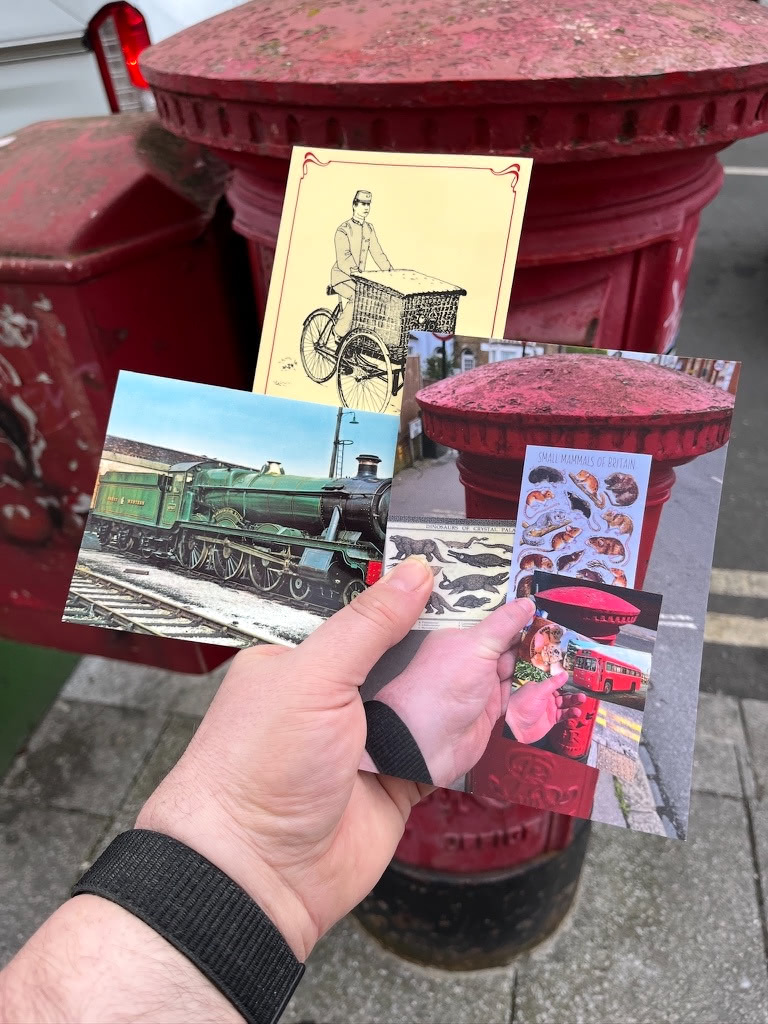
Another photograph in David's continuing series, showing him posting a postcard made from a previous photograph of himself posting postcards.
Do you have any other interesting hobbies or collections?

I am a cricket umpire! I officiate in the local league and for schools. I stopped playing the game after leaving school, but got back into it about a decade ago. Turns out that taking a break of 25 years really doesn’t help one to play very well, so I decided to take up umpiring instead – and I enjoy it far more than I ever enjoyed playing!

If you enjoy watching a sport then I really recommend giving umpiring/refereeing a go. Actually learning the rules (most fans really don’t know the details) will make the game more enjoyable when watching from the stands, but being out there on the pitch in charge of the match is the absolute best place from which to watch the match.

tags: ,
67 comments Comments

  Posted on

Today we have a special guest post from Dawn (aka DJMinNL), a postcrosser who lives in the Netherlands but was born in Scotland. She recently wrote to us with a wonderfully quirky piece of postal history: the time when Scottish pillar boxes became the unlikely stars of a national “stooshie”. If you’ve ever looked twice at the lettering or symbols on a postbox, you’re going to enjoy this one!

The Scottish Pillar Box War was one of those odd moments in postal history when something as ordinary as a post box ended up at the centre of a national debate. Despite its dramatic name, it was never a real “war.” It was more of a stooshie (a good Scots word for an uproar) involving red pillar boxes, royal lettering, and a question of historical pride.

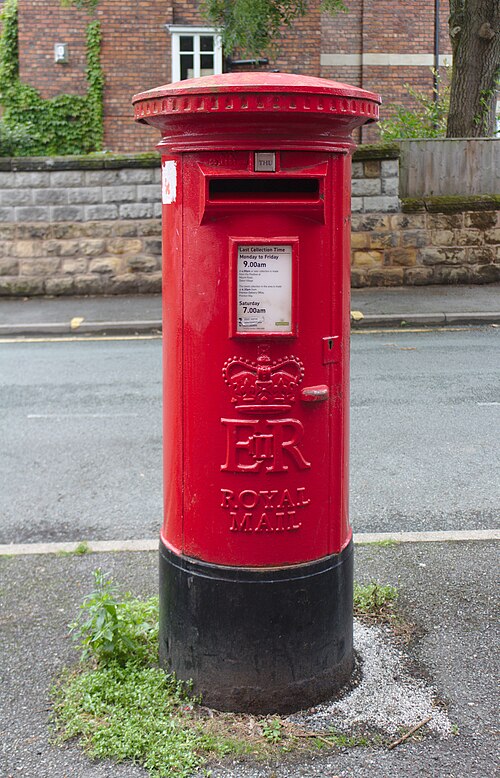
A Queen Elizabeth II Type A pillar box in Birkenhead
A Queen Elizabeth II Type A pillar box on Wellington Road, Birkenhead.
Shared by Rodhullandemu on Wikipedia.

The story began in 1952 when Elizabeth II became queen. When she chose “Elizabeth II” as her regnal number, it seemed perfectly logical in England: she was the second monarch with that name after Elizabeth I, who ruled from 1558 to 1603. But there was a small historical wrinkle. Elizabeth I ruled England and Ireland before the crowns of England and Scotland were united in 1603. Scotland, therefore, had never had a Queen Elizabeth I. For some Scots, calling the new monarch “Elizabeth II” felt like England’s numbering system was imposed on them despite the historical facts.

ER2 royal cypher
Royal Cypher of Elizabeth II of the United Kingdom

Now, constitutional debates don’t usually involve everyday street furniture. However, the new red pillar boxes operated by the Royal Mail carried the royal cypher “E II R” short for Elizabeth II Regina (“Regina” meaning queen in Latin). Suddenly, those elegant raised letters on brand-new boxes became a visible reminder of the disputed “II.”

For a small number of annoyed Scots, the solution was simple: remove the “II.” Some pillar boxes had the number scratched out or hammered flat. Others were painted over. A few suffered more dramatic treatment—one or two were even damaged with small explosives. These incidents were rare but colourful enough to attract newspaper headlines, and the whole episode soon picked up its memorable nickname: the “Scottish Pillar Box War.”

Most of the activity took place between 1952 and 1953, particularly in Glasgow and Edinburgh. The “attacks” were usually carried out quietly at night by individuals or small groups rather than crowds. One pillar box in Edinburgh became particularly notorious, it was repeatedly defaced by tar, paint, and a hammer before finally being blown to pieces less than three months after it was installed.

From a postal perspective, the damage was inconvenient but hardly catastrophic. Still, it was enough to persuade authorities that perhaps a small design adjustment would make life easier for everyone.

Post-1954 pattern Royal Mail lamp post box of the type used in Scotland, showing the Crown of Scotland.
Post-1954 pattern Royal Mail lamp post box of the type used in Scotland, showing the Crown of Scotland. Shared by Rab-k on Wikipedia.

A practical compromise soon followed. Instead of displaying the queen’s cypher, new pillar boxes installed in Scotland would simply show the Crown of Scotland. The change neatly avoided the disputed numbering while keeping a royal symbol on the box. After that, the vandalism quickly faded and the pillar boxes quietly returned to doing what they do best—collecting letters.

Interestingly, the design choice stuck. Even today, the Scottish pillar boxes continue to display the Scottish crown rather than a monarch’s cypher. When Charles III came to the throne in 2023, it was announced that Scottish boxes would keep the crown rather than adopt the new “C III R” lettering.

This episode is a reminder that post boxes are more than just practical street furniture. Their designs, ciphers, and symbols can reflect politics, identity, and sometimes a surprising amount of local feeling, for example, when Ireland gained its independence they painted the old red post boxes green.

And it raises an interesting question for Postcrossers: has there ever been similar controversies about post boxes or postal symbols in your country?

For anyone curious, the uproar even inspired a song. The lyrics to “Sky-High Joe”—a humorous take on the whole affair—can still be found online.

A fitting legacy for a dispute where, for a brief moment, the humble pillar box found itself at the centre of national attention.

35 comments Comments

  Posted on

We found Màiri (aka mairigold) through a charming owl-themed postcard exhibition she prepared for a museum in Scotland — and couldn’t wait to learn more! A lifelong postcard enthusiast, she finds joy in sharing postcards, decorating them… and even building tiny snowpeople on her red postbox! 😍

How did you get started sending postcards? What is your earliest memory of them?

This postcard was one of my most precious treasures as a child. I still like it now! Those 3D fairytale postcards seemed magical to me and I think that must have been what got me interested in postcards.

A colorful 3D postcard featuring two dolls in traditional clothing walking in a whimsical forest with animals.
How did you come across Postcrossing? What got you hooked?

I heard about Postcrossing quite by chance in 2011 when it was mentioned in passing in an online interview. I signed up immediately! Until then I had never met anyone else that liked postcards as much as I did… suddenly a whole world of fellow postcard afficionados opened up to me!

Show and tell us about your favorite received postcard to date, and what makes it special.

Impossible to choose!

Two artistic postcards from China, one featuring a hand-drawn girl and the other with the word LOVE spelled out in leaves. However, 18 August 2012 was a good Postcrossing day for me! These two beautiful postcards arrived together from China – one was drawn by Scarelt as a thank you for GB-339961 and the other (CN-627070) was sent by DogDadRory.

Show us your mailbox, your mailman/mailwoman, your postoffice or the place where you post or keep your postcards!
A classic red British postbox with a tiny snowman sitting on top, surrounded by snowy trees.

I am lucky to have this red postbox just outside my door. This is where I post my postcards. When it snows I build a wee snowperson on the top!

A collection of colorful mango boxes repurposed for storing postcards

I keep some of my postcards in these mango boxes!

What is it your favorite part of the Postcrossing process?

What I love is choosing the postcards to send. It is great when I have one that appears in someone’s favourites wishlist! I like choosing the stamps to use and writing and decorating the postcard too. I have a LOT of stickers and washi tapes as well as postcards.

Have you been surprised by any place that you have received a postcard from or sent a postcard to?

I received a postcard from Fiji which has only 17 postcrossers – quite an unusual postcard entitled “evoking spirits with a shaman’s drum”. And I sent a postcard – a map of Scotland – to a “country” I had never heard of: Saint Pierre & Miquelon, which is a French archipelago located near Canada.

Do you have any other interesting hobbies or collections?

I have a small collection of knitted or crocheted toys, which includes a wee crochet tea set and a vase of flowers, a wee knitted doll, two owls and a stripy cat.

I also have growing collection of fancy matchboxes too.

Have you inspired anyone else to join Postcrossing or start collections of their own?

I work in an art gallery and recently had a wee exhibition of (some of) my owl postcard collection in its sister museum: The Auld Kirk Museum in Kirkintilloch, Scotland.

A glass display case in a museum showcasing a collection of postcards and stamps. Close-up of postcards featuring owls, including Picasso-style sketches, Belarusian owls, and whimsical owls in hats.

Several of my colleagues share an enthusiasm for postcards and have now become Postcrossers too!

60 comments Comments

  Posted on
A box set titled The Snooty Bookshop: Fifty Literary Postcards by Tom Gauld, designed to resemble a book with illustrated shelves and characters.

Tom Gauld is a Scottish cartoonist and illustrator. He is perhaps best known by postcrossers for The Snooty Bookshop: Fifty Literary Postcards, which celebrates more than a decade of his weekly cartoons in The Guardian.

Tom has authored many books—mostly books for grown-ups, but also one of Clarisse’s preschooler’s favorites. Tom’s newest book was recently nominated for what would be his second Eisner Award. But all the accolades haven’t made him too snooty to do an email interview with Clarisse (aka CStar9)! Phew!

Pretend you’re walking onto a metaphorical sports field as the star player for this interview. What psych-up music should we play?

I’ve only had to choose walk-on music once in my life, for a talk in Madrid at a fancy venue. I overthought it for weeks, swinging between cheesy and pretentious choices, but eventually I plumped for “Let’s Come to an Arrangement” by Martin Creed because it felt suitably upbeat and noisy in a funny, slightly weird way. Plus he is Scottish, like me.

What are some of the elements that define your work across your cartoons, graphic novels, children’s books, and more? In 5 words or less, what do you hope people take away?
A spread showing illustrations from The Little Wooden Robot and the Log Princess, depicting a workshop and a magical transformation scene.
Pages from The Little Wooden Robot and the Log Princess

I try to use the language of comics in new ways, while bringing in science, literature, lists, diagrams, games, and puzzles. I want my images to be clean and easy to read, but also to have a hand-made quality with a bit of wobble to the lines and hand-written text.

I don’t really have any kind of agenda or big plans to push. I just want to entertain the audience in a reasonably intelligent way and have them go away (in 5 words) “feeling a little bit happier.”

You’ve mentioned that your job is “to be silly about intelligent subjects.” Why books/literature, and why science?

The mercenary answer is that I get paid to draw on these subjects. The Guardian asked me to do weekly cartoons about books about 16 years ago. Then New Scientist hired me about 8 years ago to do science cartoons. But I don’t think they would have asked if there wasn’t something in my work already that suited the subjects. Certainly I couldn’t have made so many if I wasn’t interested in these subjects.

On some level, literature and science are both about trying to understand the world. There is enough in that (or in people failing to understand the world) to keep me going. Plus, new stories come up every week about advances in science or happenings in the literary world and these can inspire cartoons.

A comic panel with scientists in front of a blackboard discussing equations, a wormhole, and green poodles on the wall.
Comic from Gauld’s book, Department of Mind-Blowing Theories
You submit a weekly cartoon for both The Guardian and New Scientist. What do you do about creative block? Is there a strip you can point to and say, that was HARD WON?

Weekly deadlines really help me avoid creative block. I have no choice but to hand in something by a certain day, so in a way, that frees me from feeling it has to be perfect.

Some weeks I can’t come up with anything that feels really good to me, so I just have to take my least bad idea and make it work as well as possible. And sometimes (quite often actually) I realise later that the ‘least bad idea’ was actually a pretty good idea. I just was too tied up in the creation to be a good, objective judge of its merits.

I have a cartoon called “My Library” which is a diagram where books on shelves are colour-coded into categories like “read”, “intending to read”, “pretend I’ve read” and “read, but can’t remember a single thing about it”.

A colorful library illustration labeled My Library with books categorized by humorous statuses like read, half-read, and purely for show.
“My Library” cartoon, as described in the running text

I have a really clear memory of writing and rewriting those categories and feeling that it was a rather mediocre cartoon and saying to myself, “I’ll have to try extra hard next week to make up for this.” But then it was published and people related to it and found it really funny.

I’ve learned that as you rework a joke, you become overfamiliar with it and lose the initial unexpected spark of humour. But that spark will (hopefully) be there for the reader, so you’ve just got to trust that your past-self was onto something.

As for creative blocks on longer projects without weekly deadlines, which is something I struggle with: I don’t have an answer other than to just try to keep going.

A comic-style web popup warning about bawdy poems with a checkbox confirming age over sixteen in Shakespearean language.
What is your relationship to paper broadly, and specifically to postal mail? And, when can we expect your next postcard set?

I like making work that gets shared around. When I left college in 2001, we were still mainly promoting ourselves with printed stuff, so I made a few postcards to put in with orders for my mini-comics. People seemed to really like them, so I self-published a book of postcards called Robots, Monsters, etc. which outsold all my other self-published comics.

I’ve since made one other set of postcards myself. As you know, The Snooty Bookshop was properly published by Drawn & Quarterly. I’ll certainly do another at some point, but I have other projects queued up first.

Who would you say have been your main influencers? How does your work differ from theirs?

One big influence is Edward Gorey (who also did lots of postcards). I discovered his work in the library when I was studying at Edinburgh College of Art, and it just blew me away. He used the tools of comics and picture books in a unique and brilliant way. His work gave me permission to make comics without feeling I had to follow all the rules or fashions of the form.

I think I’m probably more interested in straightforward storytelling and jokes than Gorey was, but my drawing is definitely inspired by his, as is my interest in visual games.

A comic strip humorously depicting Wordle addiction with a conversation between a person and a therapist.
What’s a hobby you love, or a new skill you’re practicing, outside of your work?

My wife’s father has an old house in the countryside which has lots of old dry stone walls, some of which were falling down. Over the last few years, I’ve been putting them back together. It’s extremely satisfying. I’ve fixed all of them now, but there are a few bits I want to redo. It’s fun to do something with my hands where I don’t also have to think about what I’m saying.

A comic titled Baking with Kafka featuring Kafka’s existential reflections alongside a recipe for lemon drizzle cake.
Tell us about your studio.

Some years ago, I was in a big shared workspace with lots of other creative people, but the area gentrified and sadly the landlord put the rent up too much, so we all scattered. I’m now in a smaller place with two other artists. I worked at home a bit over covid but I prefer having a separate place to go to work, and some company when I’m there.

In the studio, I have a drawing desk, a computer desk, a “thinking” chair, and lots of books. The room upstairs is let to a musician, so we sometimes get piano music and singing drifting down, especially in summer when the windows are open. It’s very nice.

What’s next for you?

I want to make a new graphic novel. Writing my previous ones (Mooncop and Goliath) was probably the hardest thing I’ve done. I think my brain is more suited to short cartoons, but I love the form of the graphic novel so I keep trying.

A spread from Mooncop by Tom Gauld showing a lunar police station and an astronaut in a minimalistic sci-fi scene.
Pages from Mooncop

I’m continuing to make my two weekly cartoons, so work on other projects has to squeeze into the gaps and can be rather slow. But I’m excited about the possibilities of creating a longer story again.

You can explore more of Tom Gauld’s whimsical world on his website, Instagram, and Twitter. Dive into his weekly comic strips for The Guardian and New Scientist, or take a peek inside his studio to see where the magic happens. For aspiring cartoonists, Tom shares his journey and offers advice, while fans of his work can delve into the inspirations behind his beloved books, from the literary and scientific riffs in Revenge of the Librarians and Baking with Kafka to the heartwarming tales in his children’s book (which is SO GOOD!) The Little Wooden Robot and the Log Princess. And last but not least, don’t miss his reflections on crafting stories on the themes of nostalgia and isolation in his graphic novels Mooncop and Goliath.


And now, for the traditional giveaway! Clarisse is going to send 4 postcards from Tom’s Snooty Bookshop or from his (sadly sold out) new set of cards to 4 randomly picked postcrossers. To participate, you have to tell us one book or scientific discovery you’d recommend to an alien visiting Earth — what would it be? Leave a comment below, and come back this time next week to check out the winners!

And the winners of this giveaway, as chosen by Paulo’s random number generator are… Hafizaa, eselbox, Gummu and LulaandLittle! Congratulations, and thank you all for participating!

61 comments Comments

  Posted on

Chris (aka chrisbonham11)'s profile caught our attention because of his quest to find a set of postcards featuring the Qing court version of “Up the River During Qingming”, a beautiful painting which can be seen at the National Palace Museum in Taipei. Normally, when you buy a postcard at a museum, the postcard will feature a whole painting… but this 11 meter scroll has so much going on that numerous postcards were created to feature its different scenes! Chris took the time to tell us about his quest and his other passions, on this spotlight interview!

How did you get started sending postcards? What is your earliest memory of them?

When I was a child, my family and I would send postcards to relatives from our holidays. We also received postcards from our relatives from their holidays. I especially remember postcards from my Nan, which she sent from her trips to other parts of the UK.

How did you come across Postcrossing? What got you hooked?

How exactly I came across Postcrossing back in 2014 is now lost in the mists of time, alas! I believe that I found out about it thanks to an online news article though. As somebody who studied abroad on exchange for a year during their degree, and at the time was just starting out on a career in international education, any opportunity to connect with folks abroad really appealed. I was also looking for opportunities to practice my German and Dutch, and quickly found out that there are a lot of speakers of both languages who are postcrossers. I had a little stash of postcards from museums and galleries already to hand and ready to share, so I was good to go.

A freshly painted, bright red pillar postbox
Show us your mailbox, your mail carrier, your postoffice or the place where you post or keep your postcards!

I use any one of a number of local postboxes for my outgoing postcards, depending on where I’m heading when I head out and about. I think I saw somewhere that the UK has among the densest distribution of postboxes of any country in the world, which if true is why I have so much choice! The postbox I use most frequently though is this one, located on the university campus where I work. This photo was taken in August 2023, when it had just had a fresh coat of paint.

What is it your favorite part of the Postcrossing process?

For me, it is picking out the best postcard I can for the recipient. I read every profile in full, and then have a look at their received and favourite postcard galleries. I’ve developed a greater interest in (and stash of) postage stamps over the past couple of years, hence where I can I also try to use one or more which match the recipient’s interests to pay the postcard’s way.

Show and tell us about your favorite received postcard to date, and what makes it special.

If I have to pick favourite postcards, they’re those I’ve been sent from the artwork Up The River During Qingming!

A reproduction of a 18th century painting, featuring lots of small figures crossing a stone bridge, on a busy festive day

I’ve received parts #3 from gene1128 (TW-3307201), #6 from ipyngtsai (TW-2990803), #9 from Pe-June (TW-2524342), #23 from EmilieLin (TW-3336740) and #24 from chuanH (TW-3077188).

I bought a set of postcards of this artwork from the National Palace Museum in Taipei, Taiwan, when I visited nine years ago. After I shared the set with other postcrossers, I wondered if I could rebuild the set from postcards sent to me by others. Folks may have had to go to extra trouble to obtain and send me one of these postcards (and the postcrosser who sent me four cards from the set and let me know that the Museum shop was no longer selling it certainly did go to extra trouble), hence the extra appreciation. Thank you again!

Have you been surprised by any place that you have received a postcard from or sent a postcard to?

For received postcards, it has to be Bahrain, Belize, Brunei, and Guam, four of the less common places postcrossers are from / visit in travel mode. I don’t think that any other sent postcard can match the one which took 284 days to reach its recipient in Vietnam! Never give up hope on those travelling postcards, folks, even post-60 day expiry!

Have you met any other members in real life?

For over six of the nearly ten years I’ve been a postcrosser, I beavered away at it alone. I wasn’t a user of the old forum, being a bit intimidated by the formatting. I joined the new, friendlier formatted (to me) forum in early 2021, and since then have got to know a grand bunch of people in the British Isles section. It’s a lovely corner of the Internet. I attended my first meet-up in December 2022, meeting a few of these folks and others, and haven’t looked back. I managed to attend five meet-ups in 2023, including one I hosted around Halloween in Reading. JennyAssis helped with designing the meet-up postcard for that one (thank you again, Jenny!).

Halloween Meet up Postcard, back and front
What’s one way that postcards have changed your life for the better?

The whole process of Postcrossing, from drawing an address, picking out postcard and stamps, and writing a message, is an escape for me. If I’ve had a particularly large postal delivery in one day, I can spend an hour or more reading and registering postcards and writing thank you messages to their senders. During the days of Covid lockdowns, Postcrossing kept me occupied and connected to others. While others completed Netflix, I sent and received a lot of postcards!

Is there anything else that you are passionate about?

Real ale! I’ll be wandering around Reading and east Berkshire come the Spring taking in pubs on the local CAMRA (Campaign for Real Ale) ale trail. Postcrossing friends can attest to this: I left a meet-up last summer early so that I could return to Reading to collect the t-shirt which was the reward for visiting all the pubs on last year’s trail!

International education is also a passion; I’m still working in the field, and haven’t tired of helping students realise an exchange like I did.

tags: ,
29 comments Comments