Today we have a special guest post from Dawn (aka DJMinNL), a postcrosser who lives in the Netherlands but was born in Scotland. She recently wrote to us with a wonderfully quirky piece of postal history: the time when Scottish pillar boxes became the unlikely stars of a national “stooshie”. If you’ve ever looked twice at the lettering or symbols on a postbox, you’re going to enjoy this one!
The Scottish Pillar Box War was one of those odd moments in postal history when something as ordinary as a post box ended up at the centre of a national debate. Despite its dramatic name, it was never a real “war.” It was more of a stooshie (a good Scots word for an uproar) involving red pillar boxes, royal lettering, and a question of historical pride.
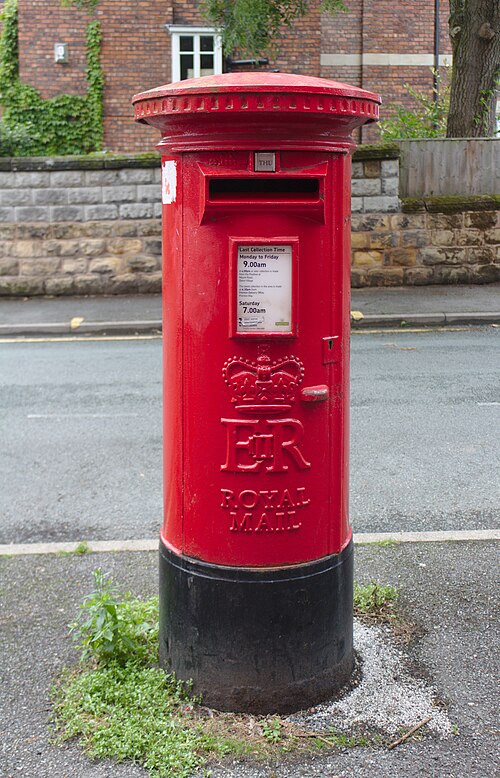
A Queen Elizabeth II Type A pillar box on Wellington Road, Birkenhead. Shared by Rodhullandemu on Wikipedia.
The story began in 1952 when Elizabeth II became queen. When she chose “Elizabeth II” as her regnal number, it seemed perfectly logical in England: she was the second monarch with that name after Elizabeth I, who ruled from 1558 to 1603.
But there was a small historical wrinkle. Elizabeth I ruled England and Ireland before the crowns of England and Scotland were united in 1603. Scotland, therefore, had never had a Queen Elizabeth I. For some Scots, calling the new monarch “Elizabeth II” felt like England’s numbering system was imposed on them despite the historical facts.
Royal Cypher of Elizabeth II of the United Kingdom
Now, constitutional debates don’t usually involve everyday street furniture. However, the new red pillar boxes operated by the Royal Mail carried the royal cypher “E II R” short for Elizabeth II Regina (“Regina” meaning queen in Latin). Suddenly, those elegant raised letters on brand-new boxes became a visible reminder of the disputed “II.”
For a small number of annoyed Scots, the solution was simple: remove the “II.” Some pillar boxes had the number scratched out or hammered flat. Others were painted over. A few suffered more dramatic treatment—one or two were even damaged with small explosives. These incidents were rare but colourful enough to attract newspaper headlines, and the whole episode soon picked up its memorable nickname: the “Scottish Pillar Box War.”
Most of the activity took place between 1952 and 1953, particularly in Glasgow and Edinburgh. The “attacks” were usually carried out quietly at night by individuals or small groups rather than crowds. One pillar box in Edinburgh became particularly notorious, it was repeatedly defaced by tar, paint, and a hammer before finally being blown to pieces less than three months after it was installed.
From a postal perspective, the damage was inconvenient but hardly catastrophic. Still, it was enough to persuade authorities that perhaps a small design adjustment would make life easier for everyone.
Post-1954 pattern Royal Mail lamp post box of the type used in Scotland, showing the Crown of Scotland. Shared by Rab-k on Wikipedia.
A practical compromise soon followed. Instead of displaying the queen’s cypher, new pillar boxes installed in Scotland would simply show the Crown of Scotland. The change neatly avoided the disputed numbering while keeping a royal symbol on the box. After that, the vandalism quickly faded and the pillar boxes quietly returned to doing what they do best—collecting letters.
Interestingly, the design choice stuck. Even today, the Scottish pillar boxes continue to display the Scottish crown rather than a monarch’s cypher. When Charles III came to the throne in 2023, it was announced that Scottish boxes would keep the crown rather than adopt the new “C III R” lettering.
This episode is a reminder that post boxes are more than just practical street furniture. Their designs, ciphers, and symbols can reflect politics, identity, and sometimes a surprising amount of local feeling, for example, when Ireland gained its independence they painted the old red post boxes green.
And it raises an interesting question for Postcrossers: has there ever been similar controversies about post boxes or postal symbols in your country?
For anyone curious, the uproar even inspired a song. The lyrics to “Sky-High Joe”—a humorous take on the whole affair—can still be found online.
A fitting legacy for a dispute where, for a brief moment, the humble pillar box found itself at the centre of national attention.
We found Màiri (aka mairigold) through a charming owl-themed postcard exhibition she prepared for a museum in Scotland — and couldn’t wait to learn more! A lifelong postcard enthusiast, she finds joy in sharing postcards, decorating them… and even building tiny snowpeople on her red postbox! 😍
How did you get started sending postcards? What is your earliest memory of them?
This postcard was one of my most precious treasures as a child. I still like it now! Those 3D fairytale postcards seemed magical to me and I think that must have been what got me interested in postcards.
How did you come across Postcrossing? What got you hooked?
I heard about Postcrossing quite by chance in 2011 when it was mentioned in passing in an online interview. I signed up immediately! Until then I had never met anyone else that liked postcards as much as I did… suddenly a whole world of fellow postcard afficionados opened up to me!
Show and tell us about your favorite received postcard to date, and what makes it special.
Impossible to choose!
However, 18 August 2012 was a good Postcrossing day for me! These two beautiful postcards arrived together from China – one was drawn by Scarelt as a thank you for GB-339961 and the other (CN-627070) was sent by DogDadRory.
Show us your mailbox, your mailman/mailwoman, your postoffice or the place where you post or keep your postcards!
I am lucky to have this red postbox just outside my door.
This is where I post my postcards.
When it snows I build a wee snowperson on the top!
I keep some of my postcards in these mango boxes!
What is it your favorite part of the Postcrossing process?
What I love is choosing the postcards to send. It is great when I have one that appears in someone’s favourites wishlist! I like choosing the stamps to use and writing and decorating the postcard too. I have a LOT of stickers and washi tapes as well as postcards.
Have you been surprised by any place that you have received a postcard from or sent a postcard to?
Do you have any other interesting hobbies or collections?
I have a small collection of knitted or crocheted toys, which includes a wee crochet tea set and a vase of flowers, a wee knitted doll, two owls and a stripy cat.
I also have growing collection of fancy matchboxes too.
Have you inspired anyone else to join Postcrossing or start collections of their own?
I work in an art gallery and recently had a wee exhibition of (some of) my owl postcard collection in its sister museum: The Auld Kirk Museum in Kirkintilloch, Scotland.
Several of my colleagues share an enthusiasm for postcards and have now become Postcrossers too!

.jpg "ER2 royal cypher")
.jpg "Royal Mail Lamp Box (Scotland)")
.jpg "ER2 royal cypher")
.jpg "Royal Mail Lamp Box (Scotland)")

 However, 18 August 2012 was a good Postcrossing day for me! These two beautiful postcards arrived together from China – one was drawn by


.jpg)