Postcrossing Blog

Stories about the Postcrossing community and the postal world

Viewing posts tagged "stamps" View all

  Posted on

Antonio Alcalá is one of four US Postal Service art directors tasked with designing US postage stamps — including the new Postcrossing stamps coming out later this month! 😍 For 35 years, his Virginia-based studio, Studio A, has also designed books, exhibits, and more—winning local, national, and international awards for design excellence.

Sometime ago, Antonio answered some of Clarisse’s (aka CStar9) questions about USPS stamp design, shared his thoughts on the important role of stamps in society, and described his first official postcard exchange as a postcrosser!

Collage of USPS stamp designs including a Lunar New Year animal, two sailboat postcard stamps, a Women’s Soccer stamp, an Art of the Skateboard stamp, a Freedom flag stamp, and a pattern stamp.
A selection of 2023 stamps for which Antonio was the art director and/or designer.
You’ve described stamps as “one of the few ways that our country officially brands itself.” I agree! What’s it like to be in the kitchen where the soup is made?
USPS Earth Day Forever stamp with a simple illustration of the Earth surrounded by green marks.
Antonio was both artist and designer for this 2020 stamp.

Being in the kitchen is exciting and exhilarating, but also complex and challenging. We may work on a single “recipe” for years and not be able to discuss any of the process except with our USPS colleagues.

And yes, stamps are a kind of brand. A brand is the outward projection of a company or organization’s personality: What do they represent? What do they want to project in terms of values?

In the case of the United States, we use the flag and our currency to communicate the ideals we want people, regardless of where they are, to associate with our country. Stamps work similarly. They are official, US-approved images that go everywhere in the nation to announce, “These are the people and subjects we feel represent the best of America.”

The stamps get produced in the tens of millions and people see them almost every day. There aren’t many other pieces of design with that kind of reach.

What are some of the unique challenges of stamp design? Have working through any of these peculiarities influenced Studio A’s larger body of design work (books, exhibits, etc.)?

There are many challenges unique to the stamp design experience. Ironically, the biggest challenge is working with such a small format. Creatives are used to working at a much larger scale, and the transition to stamp dimensions can sometimes be rocky (too much detail, colors that start to blend together, compositions that feel cramped, etc.).

The biggest lessons that have influenced my other work have to do with legal issues like copyright law, rights and permissions, etc.

Grid of six different USPS Forever stamps: a red “Forever” typographic stamp, a Harvey Milk stamp, a Lunar New Year animal stamp, a “love” hearts stamp, a Hip Hop DJ stamp, and a red silhouette stamp.
Select stamps from the past decade, for which Antonio was the art director and/or designer.
You came to the stamp design world unexpectedly (and late in life), after designing exhibits for the National Postal Museum. If you could go back and chat with your younger self as a History major at Yale, what would you tell him?

I would tell him to continue doing what he was doing because it will get me where I am today!

If, however, I was to change the path somehow, I would tell the student it is more-than-okay to study the arts in college. The world needs more creative thinkers.

How long does stamp design take? What is the average timespan that elapses between Citizens’ Advisory Committee approval of an idea and the official stamp release date?

On average, stamps take two to three years, from assignment to issuance.

Some stamps are designed as singletons, sometimes a set is a pane of 4, and sometimes there are twenty designs in one set. How are those decisions made, about numbers?
USPS stamp sheet titled “Views of Our Planets” with rows of planet images on dark backgrounds.
A 2016 issue for which Antonio was art director and designer.

We issue what we think the subject demands.

Generally, we try to limit the number of stamps in an issuance because it can get expensive for collectors who want to make sure they have one of each stamp.

I recently finished an assignment that started with four designs. Later, it evolved to ten stamps.

Sometime the subject is complex and requires the ability to show variation. Additional stamps can also make the sheet feel more compelling.

What does research look like for you?

Research can be a deep dive, going down a rabbit hole-like experience, or it may be fairly light. It may involve reading published books and magazine articles, or having conversations with consultants who are experts in the subject. USPS also contracts with a firm who helps me locate appropriate materials based on my requests.

When I’m looking for artists to partner with, it might involve looking through Instagram or online portfolios searching for what I feel is a good match for the assignment.

Four-panel sequence showing the design process of a stamp: pencil sketches evolving into a finished colourful “Woodstock 1969” peace-and-music stamp with a white dove.
Antonio’s design process for the 2019 Woodstock 50th Anniversary stamp, centering a dove graphic from the original 1969 poster by Arnold Skolnick.
What is your own relationship to snail-mail, and how has that evolved over time? Anything you want to say to Postcrossers?
USPS stamp sheet titled “message monsters” featuring cute cartoon monsters and doodles in bright colours.
Antonio was art director for this 2021 issue (my fave).

I love snail-mail! I like writing and receiving letters and cards, although I seem to have less time to do it these days. I still pay most of my bills the old-fashioned way (by mail). It’s always a thrill to put one of my stamp designs on an envelope before slipping it in the mailbox.

I once registered for Postcrossing. My card went to China (and took a long time to get there and be registered), and I received a card from the Netherlands. It’s so fun! Unfortunately, I no longer have the time to be an active participant.

As for Postcrossers, THANK YOU! You are engaging in a fantastic activity that helps bring people from around the world together. Please keep up your creative mailings!

What excited you most about bringing Postcrossing onto a U.S. stamp issue, and what did you want the set to communicate?
Portrait photo of artist Antonio Alcalá (head-and-shoulders).
Photo by Cade Martin

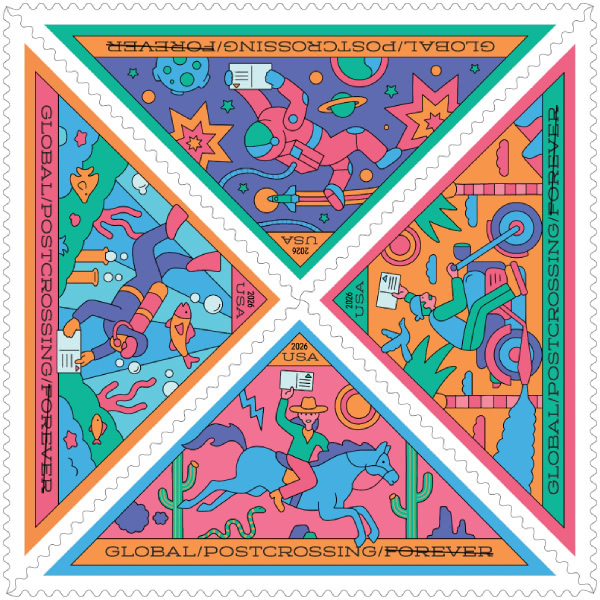
I knew Postcrossing as an international phenomena, and the US stamp program did not yet have a stamp specific to that activity. Announcing this fun, mailing activity to the country via a stamp was an amazing opportunity. The stamps are meant to be distinctive, lightly humorous, and colorful stamps communicating no matter where you are or what you do, getting and sending mail is a joy!

These stamps are triangular, which is a rare format for USPS! How did that shape influence the creative direction or composition?

Early in the development process I thought this might be a good opportunity (good subject/receptive audience) to create a stamp with a non-traditional shape. Our Global Forever stamp is usually a circle, so creating one as a triangle seemed like a fun alternative. Because I decided on this approach before hiring an illustrator, Jackson Gibbs had to work with the unusual shape from his first sketches. He got it right away and did an amazing job adapting the four “stories” to the unconventional shape.

For people that might not know, what does “art director” mean in practice for a stamp issue like this? What parts did you shepherd from start to finish?

Each of the USPS commemorative stamps is assigned to an art director. Most often, that starts with the topic and occasionally some background information. How the assignment is approached, however, is left up to the art director. In this case, I looked at what other countries around the world have published as a Postcrossing stamp. I also talked with people who are philatelists AND Postcrossing enthusiasts to get their perspectives. I then developed ideas about what I hoped to communicate and the general tone of the stamps. At this point, I also decided to try the stamps in a triangular format.

Sheet of four colourful triangular “GLOBAL/POSTCROSSING/FOREVER” USA stamps forming a square shape, with playful scenes (astronaut, cyclist, diver, and cowboy on horseback).
The four different Postcrossing stamps being issued by USPS on May 23.

My next step was looking for an illustrator to collaborate with on the assignment. After looking at numerous options, I asked to work with Jackson Gibbs. I envisoned his playful, colorful illustrations appealing to a wide range of people from young to old. Jackson provided preliminary sketches and from those I decided on the four primary subjects. The next step was for me to determine the typography, and to identify the small changes that need to be made on each stamp until everything looked just right. The other part of my job is to communicate with USPS and the Citizens Stamp Advisory Committee the progress of the job, making updates based on their suggestions, and then presenting the final set of stamps. Finally, I prepare all the materials for our pre-press team, who turns them into files for the printers.


Our huge thanks to Clarisse for putting together such thoughtful questions, and to Antonio for taking the time off his busy schedule to answer them!

And now… a little celebration! 🎉 To mark the upcoming USPS Postcrossing stamp issue, we’re giving away 10 postcards franked with these new triangular Postcrossing stamps. If you’d like to enter, just leave a comment below and tell us: which of the four stamp designs is your favourite, and why? We’ll pick 10 winners at random and send them a postcard from the First Day of Issue ceremony. Good luck! 💌

463 comments Comments

  Posted on

Chrissy Lau is an award-winning, British-born Chinese designer/illustrator based in Sydney, Australia. Her designs are inspired by her Chinese heritage and are instantly recognizable by her signature delicate lines and intricate patterns.

A sheet of Christmas Island stamps on the theme of the Lunar New Year of the Ox 2021

Chrissy took the time to answer Clarisse (aka CStar9)'s questions via email last summer, including sharing her unexpected journey from law school to full-time illustration, the many ways her family and culture influence her work, and why she always begins her drawings on A4 paper. Lunar New Year is just around the corner, so this seems like a nice time to publish her interview here on the blog!

A photo of Chrissy in her studio
Photo courtesy of Chrissy Lau
Your recognizable style carries across many different media (stamps, Royal Mint coins, sculpture, labels, murals, books). I learned from another fantastic interview that you’re a self-taught artist. Wow! What was your journey to professional art?

Ever since I can remember, I loved drawing. It had never dawned on me to pursue a creative career, it was just something I did to express myself. I was also very academic. I went to a private high school where they focus on careers such as medicine or law… which is why I graduated with a law degree.

I never became a working barrister; I knew after two weeks of law at uni that I didn’t like it. I carried it on anyway, as I thought it would be a good degree to have! A bit silly, but you feel responsible when you grow up with two parents who left school very young and worked very hard at their Chinese takeaway. They were always very supportive of any decisions I made, but I put that pressure on myself to finish my degree.

A few of Chrissy's designs. Some of the illustrations are featured in coins and wine bottles.
A few of Chrissy’s designs (explore more in her portfolio!)

Growing up, everyone was so encouraging about my drawings and always told me how creative I was but I never considered it as a career. There was an insane amount of reading to do at uni, so I drew more and more to keep myself sane. After uni I decided to see if I could sell my drawings. I still didn’t have the courage to pursue illustration full-time, so I continued with commissions at night whilst juggling various day jobs.

You took the plunge in 2013 to work as an illustrator full-time. What was your first postal commission?

An envelope featuring Guernsey Post's Lunar Year stamps for the year of the horse My first postal commission was Year of the Horse 2014 for Guernsey Post (read more about that philatelic series here).

Since then, I have illustrated each animal zodiac. 2024 will be the Year of the Dragon. The final animal of the series will be the Snake, in 2025—that will be a full zodiac collection of stamps.

In 2021, Australia Post commissioned the Year of the Ox, and I’ve continued with them on an annual Zodiac series. Australia Post's Christmas Island stamps for the New Year of the Tiger. Australia Post's Christmas Island stamps for the New Year of the Rabbit

In general, do you approach stamps differently than other work?

Stamps are really small, so the designs need to be eye-catching and not too detailed for technical/manufacturing reasons. The stamps I create for Guernsey Post and Australia Post are gold embossed (or foiled), so there needs to be enough breathing space between the lines as well as a minimum line weight so that they can be printed correctly.

What’s your personal relationship to paper in general, and to postal mail specifically?

I always sketch on paper. I need something physical to hold and see in order to get started. I like plain A4 printer paper. If the paper is too nice, or if it’s in a nice notebook or sketchbook, I always fear ruining it!

I like sending cards but I’m not fussed about receiving them. My family lives in England (where I’m originally from; I now live in Sydney) so I always like to send letters, photographs, and drawings to them.

Can you give us an example of how your East-meets-West identity manifests in your work?

I take my experience of growing up in England (1984–2007) and Australia (2007+) and mix it with my experience of being British-born Chinese. I have only lived in the Western world, so the inspiration/imagery of Chinese culture is what I’ve seen in England and Australia.

Illustration from Chrissy’s interactive<br/>
StoryBox animation My Father's story
Illustration from Chrissy’s interactive
StoryBox animation, My Father’s Story

My late father was my biggest inspiration and a fountain of knowledge when it came to learning the deeper meanings and symbolisms of Chinese culture. My dad had an incredible journey climbing over the border from China to Hong Kong when he was 10, to escape poverty. He was a big believer in feng shui and also very superstitious, so we always had long chats about my designs as well as Chinese history and Chinese art. When I create Asian-influenced art, it runs quite deep with meaning and symbolism as I pay homage to my heritage and my dad’s influence, whilst also creating something mesmerising to draw in anyone of any heritage. I grew up in Northern England and pretty much experienced racism on a daily basis, so to create Asian-inspired art means I am sharing my culture/heritage to create more familiarity and less hostility.

The stamps I create are launched from the West, but they are also sold in China and other Asian countries, so before they’re approved, we seek feedback from Chinese stamp experts.

I spend lots of time researching to ensure each object in the illustration represents something meaningful in Chinese/Asian culture. It’s important for me to create beautiful art that is intriguing and enticing and can be enjoyed by the viewer in a way that invites them to find out the deeper meanings behind the art.

Chrissy in her studio, a view from above, featuring her at her desk surrounded by artwork
Chrissy in her studio. Photo courtesy of Chrissy Lau.
The foundation of your artwork seems to be fountain pen and ink. How does that manifest in the digital age?

Before 2018, my art was very detailed and hand drawn: lots of black ink and splashes of red. I really enjoyed the style of block printing, so I liked to emulate that. I also drew a lot of hair with fine lines and lots of patterns. In order to become more commercial, I have had to evolve and inject more colour into the art whilst retaining my signature patterns.

In late 2018, I started to use an iPad to create art. I was very skeptical, but it was recommended to me by Luke Shadbolt who is a very talented photographer and husband to fashion influencer Nicole Warne. I was commissioned by them to do some illustrations for their wedding invitations, and they both said the iPad was a game changer for them. I haven’t looked back since – a small investment but one that has paid dividends.

chrissylau10

My old process was hand-drawing sketches, scanning and emailing to the client, and once they were approved, I would outline in fountain pen and rub out the pencil marks. If I didn’t have a firm hold of the paper it would scrunch along with the eraser! I would then scan the outline and email to the client. Once it was approved, I would colour digitally in Photoshop on my laptop (I taught myself how to use Photoshop when I was 12, so years later it came in handy!).

My new digital process cuts out scanning/erasing, which speeds things up a lot. The iPad also allows me to create artwork in vectors (vectors don’t diminish in quality no matter how much you zoom in, as opposed to raster – when you zoom in it gets blurry) on the Adobe Illustrator app. It’s like drawing with a pen and paper, and it cuts out the need to learn Adobe Illustrator’s desktop version with a mouse, which is much trickier.

What element of your job as an artist do you like the most, and why?

I enjoy the challenge of turning a brief of words into visuals. I really enjoy creating art that’s inspired by my Chinese heritage because I can share the art with my children and teach them about their culture.

What do you like least about your work as an artist?

I’m not keen when clients change the brief halfway through as I’ve already completed a lot of research and brainstorming, or they tell you it’s a rush job and then take ages to give their feedback. It’s not that bad really, though as it doesn’t happen that often.

What is something are you proud of, outside of your artwork?

An illustration featuring a person and lots of small drawings floating above their head I’m proud that I am a good problem solver. I’m good at teaching myself how to do anything I put my mind to.

In 2010, I was asked by a recruiter if I knew what search engine marketing was and if I’d be interested in a job. I didn’t know what it was, but I learned to analyse data with various formulas and turn it into a report presentation… so I got the job! I did it for three years and I didn’t actually enjoy it, but I’m quite proud that I figured it out.

I am proud of my two sons – and of the fact they can grow up worry-free. I grew up as a translator for my parents (English was their second language), so a lot of responsibility fell on me. I also worked in their Chinese takeaway from a young age; it was just what had to be done. But I am grateful that I learnt lots of skills (using a wok, counting money, preparing food).

To learn more about her Chrissy, check out her website and portfolio. Over the years, she has given several interviews — for instance, about her work for the Sydney Lunar Festival, Guernsey Post, IllustrationX or Collective magazine.


Good news, everyone! Clarisse has a few sets of postmarked FDCs featuring Chrissy’s Lunar New Year stamps to send out to some randomly picked postcrossers! 🎉 To participate, leave a comment below sharing your Chinese zodiac sign or what your plans are for Lunar New Year celebrations (if any)! Come back this time next week to check out the winners, which will be selected randomly.

And the winners of this giveaway, as chosen by Paulo’s random number generator are… KeepItReal, Annemarielouise, norma4728 and skyjuice! Congratulations, and thank you all for participating!

127 comments Comments

  Posted on

Many of you might not remember we used to have polls on the site, a looooong time ago. The last time we ran a poll on Postcrossing was back in 2011… and we seem to have forgotten all about them. Paulo stumbled on the code for polls recently and was pleasantly surprised to discover that it still works! So we decided to run a poll about something that has been intriguing us for a while: people’s preferences on the stamp types and how they adhere to postcards. Are self-adhesive stamps (that you peel off a sheet) better than stamps on gummed paper (that you lick)? Does it even matter?

But first, a bit of postal history: can you name the first stamp ever made? And who was its creator?

If your answer was Penny Black and Sir Rowland Hill, you’d be correct on all counts! In its 1837 pamphlet, Sir Rowland Hill called for “low and uniform rates” according to weight (rather than distance) and proposed the concept of stamps: a piece of paper “covered at the back with a glutinous wash”. The first gums were called cement and consisted of a mixture of potato starch, wheat starch and acacia gum. The idea “stuck”, and quickly spread from the UK to the rest of the world.

In 1964, 124 years after the release of the Penny Black, the first self-adhesive stamp was created by an unlikely country… Sierra Leone! That’s right — this African nation was the first one to give it a try, followed by a Christmas stamp from the USA ten years later… and many other countries after that.

If you’re curious to learn more about these themes, check out the Wikipedia page for Postage Stamp gum.

So back to our poll — 8495 postcrossers responded to it over the past week, and these were the results: Lick or stick?

Looks like things are more or less evenly divided! Though a large number of postcrossers doesn’t seem to have a preference, from those that do prefer a type of stamps, the choice of the majority seems to be self-adhesive stamps. That surprised me, as I expected postal lovers to prefer the traditional ones… but I can definitely understand that licking might not be for everyone and adhesive stamps can be more practical.

What about you? Which camp are you on, and why?

And last but not least, running a poll was fun! If you have ideas of other interesting polls that we could make, please share them in the comments. We’ll try not to let another 6 years go by until we run the next poll! 😅

65 comments Comments

  Posted on

Good news, everyone! We’re happy to announce that Russia, the country with the largest number of Postcrossing members, is releasing a themed stamp to commemorate the project on January 27th!

The 23 ruble stamp was designed by O. Shushlebina, measures 37×37 mm and comes in sheets of 9 stamps. Here’s what it will look like:

I <3 Postcrossing!

Quite nice, isn’t it? I think you can guess what it says, even if you don’t know much Russian! :)

To celebrate the occasion, three postcrossers in Novosibirsk, Tomsk and Moscow decided to hold a lottery to offer 60 lucky members the chance to receive a postcard with this stamp and the first day cancellation mark! If you’d like to participate on this giveaway, just leave a comment below saying you’d like to receive one. We’ll draw 60 names by the end of the week, and send your addresses to the members who are going to write you a postcard.

You might find a surprise postcard on your mailbox in a few weeks! :)

870 comments Comments

  Posted on

Hurray! The Guernsey Postcrossing stamp has just launched today and is now making its way around the world to many happy mailboxes!

Guernsey Post Postcrossing stamp! intro

In order to celebrate the event, postcrossers from the island and abroad got together today to send their first cards with the shiny new stamp. Guernsey Post kindly prepared a room for the eager postcrossers, who wrote and stamped to their heart’s content…

Guernsey Post Postcrossing stamp launch

… and ate the delicious cake a talented baker at the post office did for us! Isn’t it gorgeous?

Guernsey Post Postcrossing cake

The local newspaper and TV channel were also in attendance, and so we hope that a few islanders will find out about the project in the media tomorrow and decide to join!

Michael and the stamp

And here’s Michael (aka GIBSONMS) with the stamp! Michael was the enthusiastic postcrosser who approached Guernsey Post with the idea for a stamp.

Our big thank you to him for his initiative and to Dawn Gallienne at Guernsey Post, for deeming Postcrossing worthy of this honor. We really appreciate it!

It was a great day! Happy Postcrossing, everyone! :)


PS – If you’re interested, the stamp, postcard, and postcard+stamp+cancellation mark combos can be purchased online at the Guernsey Stamps website.

53 comments Comments