Postcrossing Blog

Stories about the Postcrossing community and the postal world

Viewing posts tagged "philately" View all

  icon

João Machado is an internationally known designer based in Portugal. Although his first love is poster design, he began designing stamps for Portugal’s national postal service in the 1980s. Since then, he has designed dozens of stamps celebrating Portugal’s national culture, ecosystems, industries, and aspirations.

Collage of João Machado’s Portuguese stamps: nature, mail, diplomacy, sport, and culture in bold colors.
A selection of Machado’s stamp designs

Sometime ago, João very generously shared his time and perspectives with Clarisse (aka CStar9) via email and postal mail.

1987 minisheet: gramophone blasting colorful shapes—‘Centenary of the Vinyl Record’ by João Machado.
You are internationally known for your poster designs. How did you begin designing stamps, which are at a very different spatial scale?

I started designing stamps in 1987 at the request of CTT – Correios de Portugal (aka, the Portuguese Post).

I made my first stamp for the centenary of the vinyl record. It was a stamp made manually (drawn and colored) without the help of computers.

What are the primary tools you use in your work?

My first work as a graphic designer was illustrating children’s books. I used pastel and cardboard templates that helped me define the shapes of each drawing. I also drew a lot with India ink.

Later, in the 70s, when posters became my great passion, I drew everything manually, using the airbrush, cutouts, and collages.
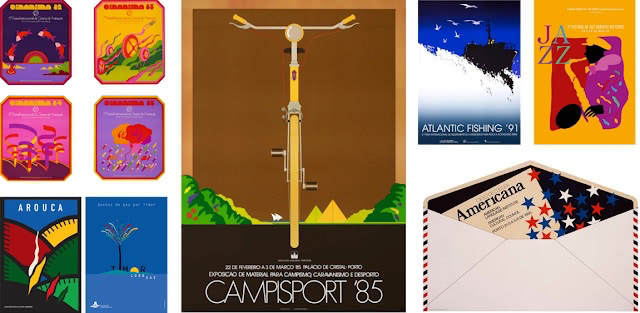
Poster montage with ‘Campisport ’85’ bike center, plus fishing, jazz, and envelope-themed designs.
A selection of Machado’s early posters

In 1987, I bought my first computer, but it was only later, in 1993, that I started using it 100%.

You’ve even designed a stamp on cork! Can you tell us about that?
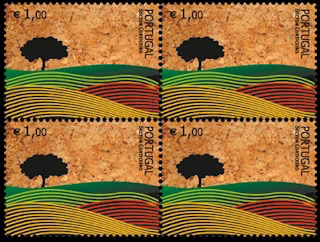
Block of four cork-textured stamps: rolling fields and a cork oak silhouette by João Machado.

I designed this stamp on ‘cork paper’ in 2007, at the request of Corticeira Amorim, a company that leads the world in this sector. This is the first stamp made in this material for Correios de Portugal, and the production was backed by Parliament.

Cork is Portugal’s only world-leading industrial sector, and the cork and cork tree are national symbols. The tree – which may live as many as two hundred years – is mainly concentrated in the centre and the south of Portugal.

Your vibrant color palette is incredible! Is it inspired by your environment or does it simply exist in your creative imagination?

There are many subjects, places, sounds, images, and even dreams that have obviously had an impact on my color palette and in my way of being an artist. I have always lived in the North of Portugal, next to the river and the sea. The northern region has always been much richer and more prolific in the colors of its crafts. But in a more general way, I am European and this geographic reality strongly influences my personality.

Influences are inevitable when we live in an open society. I’ve traveled a lot and contact with other international designers has been constant. No doubt I was influenced by the impact of Pop Art: I can highlight the influence of Heinz Edelmann, Milton Glaser, and Seymour Chwast. I remember my early works as an illustrator and poster designer were made during the 1960s, listening to the Beatles.
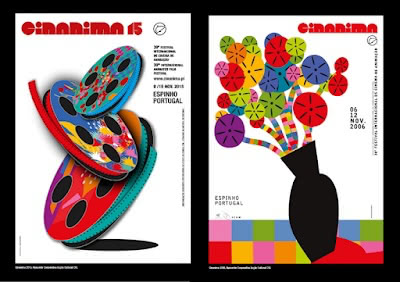
Two CINANIMA festival posters: stacked film reels and a vase of reel ‘flowers’ in vibrant colors.
Two of Machado’s posters for the International Animated Film Festival

I ended up creating a very unique chromatic code, with vibrant, clean and sharp colors, articulated without any concern for classical correspondence. For example, green does not always mean hope; black does not always mean mourning. The color of the sun or the sea are those that my imagination and intuition decide to choose.

You’ve said in a previous interview that when you approach a design, you try to land on the bright side of an issue. Can you give us an example?

I am by nature a pessimistic and introspective person, but in my work I am always focused on the positive side of the issue.

In other words, even if it is a delicate and irremediable subject, I always try to approach the content of the message in a positive and hopeful way. Environmental issues are examples of what I have just explained.
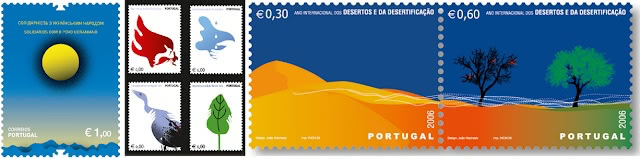
Environmental-themed stamps: sun over sea, animal icons, and anti-desertification diptych with dunes and tree.
Machado stamps with a message
When did you first see yourself as an artist/designer?
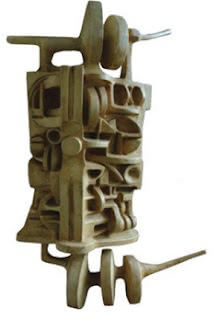
Abstract sculpture by João Machado, vertical form with carved geometric cavities and projections.
Machado. Without Title (I), 1967;
plaster; 59×38×15 cm

Since I was very little, I had a tendency to draw. When I was 14 years old and went to high school, I remember that my exercise books were filled with varied comic strips, caricatures of the teachers, and other ideas that occurred to me during lessons. I’m sure that at this age I had already decided my future!

When choosing my university career, I chose Fine Arts, which at the time included painting, sculpture, and architecture. I opted for sculpture due to my passion for the three-dimensional and strong drawing components of the course.

Later on in my work as a designer, the impact of sculpture gave me a better understanding of the three-dimensionality and “sensuality” of forms, not just those of the human figure. But the color was missing!

Graphic design gradually appeared on my path. I made the choice to dedicate myself to it, studying, observing, and creating my own language. Now, I was making my own 'watermark’.
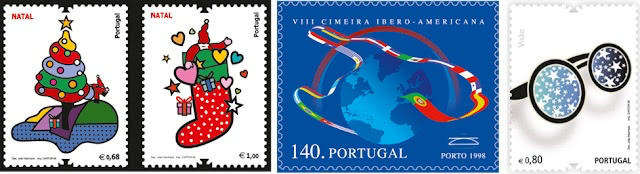
Strip of stamps: playful Christmas stockings, 1998 Ibero-American Summit globe, and snowflake glasses.
More of Machado’s stamps!

You can learn more about João on his website, or through one of the many documentaries and interviews or profiles he’s been featured on throughout the years.


And now, for a very special giveaway! Clarisse is going to send 3 of João Machado’s cork stamps to 3 randomly selected postcrossers. For a chance to win one of these exceptional specimens, let us know which stamp issue(s) from your country you consider to be the most beautiful — maybe one day, we’ll interview that stamp artist too! 😍 This giveaway will close on Saturday, November 1 November 8.


And the winners of this giveaway, as chosen by Paulo’s random number generator are… salcedou, an-foxy and Sudharshan! Congratulations, and thank you all for participating!

  icon

Every year on September 21st, the International Day of Peace is celebrated around the world. It’s a reminder that peace isn’t just the absence of conflict, but something we actively build in our daily lives, in the way we treat ourselves, our neighbors, our communities, and the planet. Small gestures of kindness, understanding, and cooperation add up, like stitches in a fabric, creating something stronger and more beautiful together.

This year’s theme for the International Day of Peace is Act Now for a Peaceful World. It’s a call to remind us that peace isn’t something abstract or far away: it’s built through our daily choices and actions. From standing up against unkindness, to listening to voices different from our own, to volunteering in our communities, each of us can play a part.

This year, several postal administrations joined forces to celebrate peace in a very tangible way: through a special embroidered postage stamp. The “Dove of Peace” stamp is literally stitched out of thread by the Austrian embroidery house Hämmerle & Vogel, and features a dove carrying an olive branch. It’s being issued jointly by postal services from Åland, Armenia, Austria, Barbados, Cyprus, Faroe Islands, Greenland, Liechtenstein, Luxembourg, Switzerland, and the three offices of the United Nations.

More than just a philatelic novelty, the embroidered Dove of Peace stamp is meant as a symbol and a commitment. Like embroidery, peace requires patience, daily effort, and care. And through the vast network of the postal system, this little dove can fly around the world carrying its message of hope and unity.

Embroidered Dove of Peace postage stamp issued by the United Nations, showing a white dove with a blue olive branch, placed on a background of dark blue thread spools.

To celebrate this initiative and World Peace Day, Austria Post and Liechtenstein Post have kindly offered us 20 of these embroidered stamps to give away (10 from each country).

To enter the giveaway, just leave a comment below sharing a small act of kindness or gesture of peace that has brightened your day recently. Comments will be opened until October 5, at which point we’ll draw 20 winners at random and have one of these special stamps mailed to them.

On this World Peace Day (and every day!), may our small acts of kindness and connection (like a postcard, a smile, or a shared story) add up to something bigger!

And the winners of this giveaway, as chosen by Paulo’s random number generator are… bookmeg, Mokidale, chen_snailmail, LarisaCox, Maestla, AnMiSa, trickykid1, Gan_Gan, blueridge_snail, Natea, Briareos, cyberfairy, jihi, Rhoda, GabberGabs, jasminen25, radiofan, Tuermerin, CCarlsen and Kimbuhlayyyy! Congratulations, and thank you all for participating!

tags: ,

  icon

We’ve mentioned #xtremephilately and #xtremedeltiology on the blog before — they’re those pictures you take when you put a stamp or postcard in front of the place featured on them. Like these:

A person holds up matching postcards and stamps in front of the real buildings they depict — a red modernist museum in the left photo, and a red brick church in the right.

But here’s something extra cool: piXPost is a new app that allows you to put those stamp and postcard pictures (as well as pictures of postboxes, post offices and events) on the map, to share with others! Graham Beck (from Youtube channel Exploring Stamps) shows you what it’s all about:

Screenshot of the piXPost app showing a Tamsui Church maxicard from Taiwan held in front of the actual church, with a short description about its history.

I’ve been taking pictures of postboxes and postcards for a loooong time now, mostly for fun, and I know lots of you do this as well. But now we can share them among us and with other postal lovers around the world, to let everyone know where these special places are! Ever since signing up, I find myself going out of my way to photograph even more postboxes, post offices, stamps and postcards everywhere. I can’t help it — I want them aaaaall on the map! And I can definitely see myself checking the app before traveling, to plan my trip around the local postal highlights. 😍

There are a few gamification aspects of the app that work really well too. First of all, you can “claim” a postbox by being the first person to pin it on the global map with a photo. That will make you “XP1” — explorer number 1! But there are also tons of fun badges to collect, for pinning a certain number of items in each category or country. It’s really fun to collect these… and a little addictive too, I must say.

piXPost is free and available on the App Store for iOS devices or on Google Play for Android ones. We hope lots of you will give it a go, so that the map gets full to the brim with fun spots for future postal adventures!

  icon

Every year, stamp lovers across Europe (and beyond!) come together to vote for the best-looking EUROPA stamp — and the time has come once more! The 2025 competition kicked off last month, and this year’s theme is “National Archaeological Discoveries”.

Archaeological discoveries tell the story of where we come from, revealing some clues about life in centuries or sometimes even millennia past. From cave art and ceremonial masks to statues, jewelry or simple tools, these items help piece together the cultural puzzle of Europe’s shared history.

According to the EUROPA stamps website:

“The highly anticipated 2025 EUROPA Stamps Competition is set to captivate philatelists and history enthusiasts alike with its theme, “National Archaeological Discoveries.” Issued by European postal operators, this year’s stamps will celebrate the extraordinary archaeological findings that have shaped Europe’s rich cultural heritage. The 2025 edition will take collectors on a journey through time, uncovering hidden treasures, ancient civilisations, and ground-breaking discoveries.”

A collage of the 2025 EUROPA stamps, each featuring archaeological discoveries from different European countries, including ancient figurines, rock carvings, pottery, and artifacts.

That said, this theme is a little trickier to turn into a visually stunning stamp… and you’ll notice many countries went with a more simple approach, showcasing the artifacts’ photos in minimalist layouts. Still, there’s something compelling about the diversity of objects and the stories behind them — and some designs found really clever ways to bring these ancient items to life!

So come learn a little about what each country chose to highlight, and cast your vote for your favorite design!

Vote for the most beautiful EUROPA stamp! 😍

And as always, we’d love to hear what you think in the comments below! Which stamp caught your eye this year? Did your country make a good pick? What other artifacts would you like to see on a stamp?

  icon

Postcrossers that received postcards from Europe last year may have noticed a colorful stamp motif gracing some of their postcards. Linda Bos and Runa Egilsdottir, a design duo known as the Designers’ Collective, created the “peace knot” stamp for POST Luxembourg’s winning entry to the EUROPA Stamp Competition in 2023.

A mashup of EUROPA stamps block sheets, all featuring the 2023 design inspired on the celtic knot
Stamp issues, first-day covers, and maxi-cards issued by European postal companies in 2023.

Last winter, Linda and Runa took time to share with Clarisse (aka CStar9) the origins of this design and their deep connection to stamps and mail.

But first, a bit more about the stamp. Each year since 1956, the EUROPA stamp program has encouraged continent-wide collaboration on stamp issues around a common theme. If you’re new to EUROPA stamps and want to learn more, check out last month’s post about them! In 2023, the EUROPA theme was “Peace – the highest value of humanity”, declared to express European solidarity with Ukraine.

The EUROPA design competition draws dozens of entries by national postal systems in Europe every year. Linda and Runa’s peace knot design won the competition for POST Luxembourg in 2023. Their design was subsequently adopted as a EUROPA stamp issue by more than 50 postal companies in Europe.

The 2023 EUROPA stamp, featuring a stylized celtic knot holding hands
The winning design
Can you tell us more about your approach to the peace knot as a graphic concept in this stamp?

We wanted the peace stamp to represent every single person in the greater region of Europe, regardless of their origin and belief.

After researching existing peace symbols, we realised they had either religious origins (like the dove and olive branch), or we sensed they were no longer suited for our time (like the common peace symbol, which started its life as a symbol of the British anti-nuclear movement), or they had evolved to having a different meaning in certain cultures (like the ‘two fingers up’).

We concluded it was time to create a new peace symbol for Europe!

When delving into the very diverse world of symbols from all over Europe for inspiration, we found the Celtic love knot to be very fitting to base our design on. The meaning behind this knot is love and connection; there are four hearts ‘hidden’ inside.

To strengthen the message of unity and cohesion, we created two sets of hands with interlaced fingers instead of the classic handshake, which in our opinion would have given it too much of a political and corporate vibe.

An earlier sketch of the design
An early sketch of the peace knot design.

We then decided to apply a colour palette derived from flag colours — and a new peace symbol was born!

We like to add that we were delighted to work on this project together with Emile Espen from Post Philately Luxembourg, who commissioned us on this project and who gave the good-to-go for this symbol.

Linda and Runa receive an award
Linda and Runa: the Designers’ Collective (accepting a German Design Award in 2018)
What is the origin story of your collaboration?

Both of us studied design. We had been working in the field separately until our paths crossed over a decade ago. There was an immediate click, both personally and professionally, so we decided to help each other out on projects. We soon realised that our skills were very complementary. We work much more effectively and raise our work to the next level, when working as a duo.

Was this your first effort to design a stamp, either individually or as a collective?

Linda designed her first set of Europa stamps in 2012, followed by the 2014 Luxembourg Christmas stamps and a special block for the 2017 Multilaterale Hertogpost Philatelic Exhibition.

The latter appeared in both the Netherlands and Luxembourg. There was a unique block containing stamps from both countries.

Other stamps designed by them
Linda Bos’s stamp issues for POST Luxembourg

We then designed some stamps commissioned by clients as a duo. The peace knot stamp was the first one commissioned by POST Luxembourg for us to design together. The success of this design proves to us that we should continue working together for sure!

What are your personal relationships to postal mail?

We love to send and receive postal mail. Of course nowadays, a large part of what once needed to be sent by postal mail has been replaced by email. But this makes it even more special to receive ‘real’ mail.

Each year we put a lot of thought into our Happy New Year card we send to our clients. We don’t believe we will ever opt for a digital version, which can never replace the excitement of opening a nice envelope and touching a card printed on special paper.

What’s next for you as a collaborative duo?

Creative world domination!

You can learn more about Linda and Runa’s work on their website, or on their Instagram and Facebook pages. You can also watch a brief interview about the peace stamp or check out Linda’s 2019 midwives stamp.