Postcrossing Blog

Stories about the Postcrossing community and the postal world

Viewing posts tagged "artist-interview" View all

  Posted on

Antonio Alcalá is one of four US Postal Service art directors tasked with designing US postage stamps — including the new Postcrossing stamps coming out later this month! 😍 For 35 years, his Virginia-based studio, Studio A, has also designed books, exhibits, and more—winning local, national, and international awards for design excellence.

Sometime ago, Antonio answered some of Clarisse’s (aka CStar9) questions about USPS stamp design, shared his thoughts on the important role of stamps in society, and described his first official postcard exchange as a postcrosser!

Collage of USPS stamp designs including a Lunar New Year animal, two sailboat postcard stamps, a Women’s Soccer stamp, an Art of the Skateboard stamp, a Freedom flag stamp, and a pattern stamp.
A selection of 2023 stamps for which Antonio was the art director and/or designer.
You’ve described stamps as “one of the few ways that our country officially brands itself.” I agree! What’s it like to be in the kitchen where the soup is made?
USPS Earth Day Forever stamp with a simple illustration of the Earth surrounded by green marks.
Antonio was both artist and designer for this 2020 stamp.

Being in the kitchen is exciting and exhilarating, but also complex and challenging. We may work on a single “recipe” for years and not be able to discuss any of the process except with our USPS colleagues.

And yes, stamps are a kind of brand. A brand is the outward projection of a company or organization’s personality: What do they represent? What do they want to project in terms of values?

In the case of the United States, we use the flag and our currency to communicate the ideals we want people, regardless of where they are, to associate with our country. Stamps work similarly. They are official, US-approved images that go everywhere in the nation to announce, “These are the people and subjects we feel represent the best of America.”

The stamps get produced in the tens of millions and people see them almost every day. There aren’t many other pieces of design with that kind of reach.

What are some of the unique challenges of stamp design? Have working through any of these peculiarities influenced Studio A’s larger body of design work (books, exhibits, etc.)?

There are many challenges unique to the stamp design experience. Ironically, the biggest challenge is working with such a small format. Creatives are used to working at a much larger scale, and the transition to stamp dimensions can sometimes be rocky (too much detail, colors that start to blend together, compositions that feel cramped, etc.).

The biggest lessons that have influenced my other work have to do with legal issues like copyright law, rights and permissions, etc.

Grid of six different USPS Forever stamps: a red “Forever” typographic stamp, a Harvey Milk stamp, a Lunar New Year animal stamp, a “love” hearts stamp, a Hip Hop DJ stamp, and a red silhouette stamp.
Select stamps from the past decade, for which Antonio was the art director and/or designer.
You came to the stamp design world unexpectedly (and late in life), after designing exhibits for the National Postal Museum. If you could go back and chat with your younger self as a History major at Yale, what would you tell him?

I would tell him to continue doing what he was doing because it will get me where I am today!

If, however, I was to change the path somehow, I would tell the student it is more-than-okay to study the arts in college. The world needs more creative thinkers.

How long does stamp design take? What is the average timespan that elapses between Citizens’ Advisory Committee approval of an idea and the official stamp release date?

On average, stamps take two to three years, from assignment to issuance.

Some stamps are designed as singletons, sometimes a set is a pane of 4, and sometimes there are twenty designs in one set. How are those decisions made, about numbers?
USPS stamp sheet titled “Views of Our Planets” with rows of planet images on dark backgrounds.
A 2016 issue for which Antonio was art director and designer.

We issue what we think the subject demands.

Generally, we try to limit the number of stamps in an issuance because it can get expensive for collectors who want to make sure they have one of each stamp.

I recently finished an assignment that started with four designs. Later, it evolved to ten stamps.

Sometime the subject is complex and requires the ability to show variation. Additional stamps can also make the sheet feel more compelling.

What does research look like for you?

Research can be a deep dive, going down a rabbit hole-like experience, or it may be fairly light. It may involve reading published books and magazine articles, or having conversations with consultants who are experts in the subject. USPS also contracts with a firm who helps me locate appropriate materials based on my requests.

When I’m looking for artists to partner with, it might involve looking through Instagram or online portfolios searching for what I feel is a good match for the assignment.

Four-panel sequence showing the design process of a stamp: pencil sketches evolving into a finished colourful “Woodstock 1969” peace-and-music stamp with a white dove.
Antonio’s design process for the 2019 Woodstock 50th Anniversary stamp, centering a dove graphic from the original 1969 poster by Arnold Skolnick.
What is your own relationship to snail-mail, and how has that evolved over time? Anything you want to say to Postcrossers?
USPS stamp sheet titled “message monsters” featuring cute cartoon monsters and doodles in bright colours.
Antonio was art director for this 2021 issue (my fave).

I love snail-mail! I like writing and receiving letters and cards, although I seem to have less time to do it these days. I still pay most of my bills the old-fashioned way (by mail). It’s always a thrill to put one of my stamp designs on an envelope before slipping it in the mailbox.

I once registered for Postcrossing. My card went to China (and took a long time to get there and be registered), and I received a card from the Netherlands. It’s so fun! Unfortunately, I no longer have the time to be an active participant.

As for Postcrossers, THANK YOU! You are engaging in a fantastic activity that helps bring people from around the world together. Please keep up your creative mailings!

What excited you most about bringing Postcrossing onto a U.S. stamp issue, and what did you want the set to communicate?
Portrait photo of artist Antonio Alcalá (head-and-shoulders).
Photo by Cade Martin

I knew Postcrossing as an international phenomena, and the US stamp program did not yet have a stamp specific to that activity. Announcing this fun, mailing activity to the country via a stamp was an amazing opportunity. The stamps are meant to be distinctive, lightly humorous, and colorful stamps communicating no matter where you are or what you do, getting and sending mail is a joy!

These stamps are triangular, which is a rare format for USPS! How did that shape influence the creative direction or composition?

Early in the development process I thought this might be a good opportunity (good subject/receptive audience) to create a stamp with a non-traditional shape. Our Global Forever stamp is usually a circle, so creating one as a triangle seemed like a fun alternative. Because I decided on this approach before hiring an illustrator, Jackson Gibbs had to work with the unusual shape from his first sketches. He got it right away and did an amazing job adapting the four “stories” to the unconventional shape.

For people that might not know, what does “art director” mean in practice for a stamp issue like this? What parts did you shepherd from start to finish?

Each of the USPS commemorative stamps is assigned to an art director. Most often, that starts with the topic and occasionally some background information. How the assignment is approached, however, is left up to the art director. In this case, I looked at what other countries around the world have published as a Postcrossing stamp. I also talked with people who are philatelists AND Postcrossing enthusiasts to get their perspectives. I then developed ideas about what I hoped to communicate and the general tone of the stamps. At this point, I also decided to try the stamps in a triangular format.

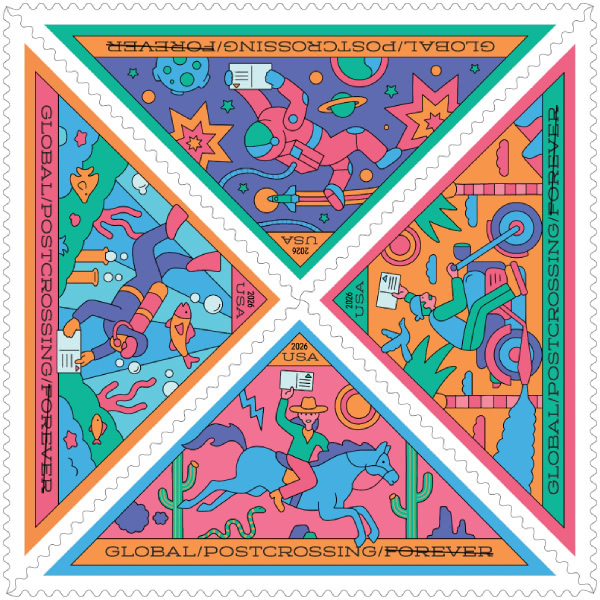
Sheet of four colourful triangular “GLOBAL/POSTCROSSING/FOREVER” USA stamps forming a square shape, with playful scenes (astronaut, cyclist, diver, and cowboy on horseback).
The four different Postcrossing stamps being issued by USPS on May 23.

My next step was looking for an illustrator to collaborate with on the assignment. After looking at numerous options, I asked to work with Jackson Gibbs. I envisoned his playful, colorful illustrations appealing to a wide range of people from young to old. Jackson provided preliminary sketches and from those I decided on the four primary subjects. The next step was for me to determine the typography, and to identify the small changes that need to be made on each stamp until everything looked just right. The other part of my job is to communicate with USPS and the Citizens Stamp Advisory Committee the progress of the job, making updates based on their suggestions, and then presenting the final set of stamps. Finally, I prepare all the materials for our pre-press team, who turns them into files for the printers.


Our huge thanks to Clarisse for putting together such thoughtful questions, and to Antonio for taking the time off his busy schedule to answer them!

And now… a little celebration! 🎉 To mark the upcoming USPS Postcrossing stamp issue, we’re giving away 10 postcards franked with these new triangular Postcrossing stamps. If you’d like to enter, just leave a comment below and tell us: which of the four stamp designs is your favourite, and why? We’ll pick 10 winners at random and send them a postcard from the First Day of Issue ceremony. Good luck! 💌

And the winners of this giveaway, as chosen by Paulo’s random number generator are… anactualcat, CarolBr, msquared47, Chirp2lou, unicorn11, PandaSnailMail, sjk7, triomom, Michaela-SK and mcrcrazedfan! Congratulations, and thank you all for participating!

503 comments Comments

  Posted on

João Machado is an internationally known designer based in Portugal. Although his first love is poster design, he began designing stamps for Portugal’s national postal service in the 1980s. Since then, he has designed dozens of stamps celebrating Portugal’s national culture, ecosystems, industries, and aspirations.

Collage of João Machado’s Portuguese stamps: nature, mail, diplomacy, sport, and culture in bold colors.
A selection of Machado’s stamp designs

Sometime ago, João very generously shared his time and perspectives with Clarisse (aka CStar9) via email and postal mail.

1987 minisheet: gramophone blasting colorful shapes—‘Centenary of the Vinyl Record’ by João Machado.
You are internationally known for your poster designs. How did you begin designing stamps, which are at a very different spatial scale?

I started designing stamps in 1987 at the request of CTT – Correios de Portugal (aka, the Portuguese Post).

I made my first stamp for the centenary of the vinyl record. It was a stamp made manually (drawn and colored) without the help of computers.

What are the primary tools you use in your work?

My first work as a graphic designer was illustrating children’s books. I used pastel and cardboard templates that helped me define the shapes of each drawing. I also drew a lot with India ink.

Later, in the 70s, when posters became my great passion, I drew everything manually, using the airbrush, cutouts, and collages.

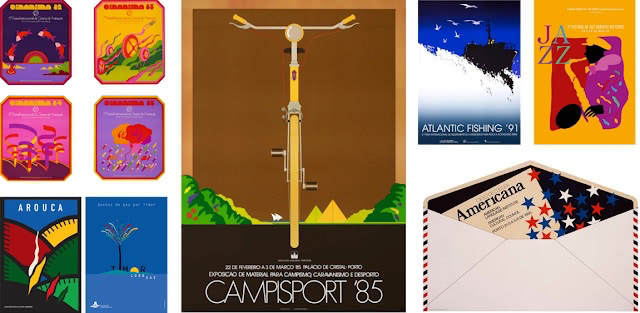
Poster montage with ‘Campisport ’85’ bike center, plus fishing, jazz, and envelope-themed designs.
A selection of Machado’s early posters

In 1987, I bought my first computer, but it was only later, in 1993, that I started using it 100%.

You’ve even designed a stamp on cork! Can you tell us about that?
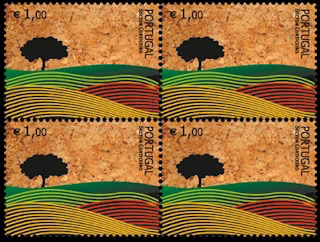
Block of four cork-textured stamps: rolling fields and a cork oak silhouette by João Machado.

I designed this stamp on ‘cork paper’ in 2007, at the request of Corticeira Amorim, a company that leads the world in this sector. This is the first stamp made in this material for Correios de Portugal, and the production was backed by Parliament.

Cork is Portugal’s only world-leading industrial sector, and the cork and cork tree are national symbols. The tree – which may live as many as two hundred years – is mainly concentrated in the centre and the south of Portugal.

Your vibrant color palette is incredible! Is it inspired by your environment or does it simply exist in your creative imagination?

There are many subjects, places, sounds, images, and even dreams that have obviously had an impact on my color palette and in my way of being an artist. I have always lived in the North of Portugal, next to the river and the sea. The northern region has always been much richer and more prolific in the colors of its crafts. But in a more general way, I am European and this geographic reality strongly influences my personality.

Influences are inevitable when we live in an open society. I’ve traveled a lot and contact with other international designers has been constant. No doubt I was influenced by the impact of Pop Art: I can highlight the influence of Heinz Edelmann, Milton Glaser, and Seymour Chwast. I remember my early works as an illustrator and poster designer were made during the 1960s, listening to the Beatles.

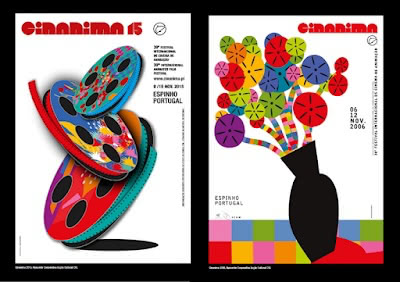
Two CINANIMA festival posters: stacked film reels and a vase of reel ‘flowers’ in vibrant colors.
Two of Machado’s posters for the International Animated Film Festival

I ended up creating a very unique chromatic code, with vibrant, clean and sharp colors, articulated without any concern for classical correspondence. For example, green does not always mean hope; black does not always mean mourning. The color of the sun or the sea are those that my imagination and intuition decide to choose.

You’ve said in a previous interview that when you approach a design, you try to land on the bright side of an issue. Can you give us an example?

I am by nature a pessimistic and introspective person, but in my work I am always focused on the positive side of the issue.

In other words, even if it is a delicate and irremediable subject, I always try to approach the content of the message in a positive and hopeful way. Environmental issues are examples of what I have just explained.

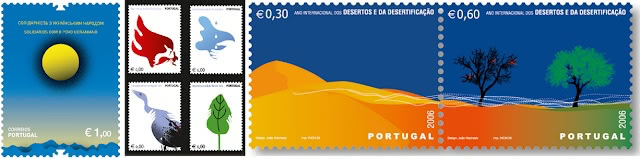
Environmental-themed stamps: sun over sea, animal icons, and anti-desertification diptych with dunes and tree.
Machado stamps with a message
When did you first see yourself as an artist/designer?
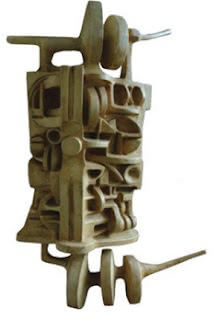
Abstract sculpture by João Machado, vertical form with carved geometric cavities and projections.
Machado. Without Title (I), 1967;
plaster; 59×38×15 cm

Since I was very little, I had a tendency to draw. When I was 14 years old and went to high school, I remember that my exercise books were filled with varied comic strips, caricatures of the teachers, and other ideas that occurred to me during lessons. I’m sure that at this age I had already decided my future!

When choosing my university career, I chose Fine Arts, which at the time included painting, sculpture, and architecture. I opted for sculpture due to my passion for the three-dimensional and strong drawing components of the course.

Later on in my work as a designer, the impact of sculpture gave me a better understanding of the three-dimensionality and “sensuality” of forms, not just those of the human figure. But the color was missing!

Graphic design gradually appeared on my path. I made the choice to dedicate myself to it, studying, observing, and creating my own language. Now, I was making my own 'watermark’.

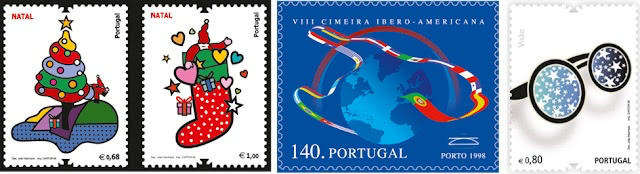
Strip of stamps: playful Christmas stockings, 1998 Ibero-American Summit globe, and snowflake glasses.
More of Machado’s stamps!

You can learn more about João on his website, or through one of the many documentaries and interviews or profiles he’s been featured on throughout the years.


And now, for a very special giveaway! Clarisse is going to send 3 of João Machado’s cork stamps to 3 randomly selected postcrossers. For a chance to win one of these exceptional specimens, let us know which stamp issue(s) from your country you consider to be the most beautiful — maybe one day, we’ll interview that stamp artist too! 😍 This giveaway will close on Saturday, November 1 November 8.


And the winners of this giveaway, as chosen by Paulo’s random number generator are… salcedou, an-foxy and Sudharshan! Congratulations, and thank you all for participating!

105 comments Comments

  Posted on

Louise Neumann (and LouPaper) need no introduction to the Postcrossing community. Her U.S. state, seasonal garden, and other themed postcards are collected by thousands of us.

She made time for an email interview with Clarisse (aka Cstar9) last summer, and we’re so grateful!

mosaic of Louise and 8 of her designs
What music should people listen to as they read this interview?

Something cheerful and whimsical! Whatever puts you in a good mood. I think that would reflect my approach to my work, and the way I want it to make people feel.

How did LouPaper get started?

When I first started LouPaper, I was trying to see if I could make a career of drawing. I have a degree in illustration, but I didn’t know how to turn my passion into something that could earn a living. After college, I did some editorial commissions and other odd art jobs, but I was still trying to find fluency in my technique and confidence in myself.

Several themed cards stacked on a table - crystals, pastries, sushi and more 2 of LouPaper's state cards: Massachusetts and Nevada, with whales, lobsters, balloons, striped rocks

I had this idea of practicing my craft by simply choosing themes that I loved and drawing them. I thought maybe I could sell them as prints, notebooks, etc.

Obvious question: Why postcards?

The day I dipped my toe into the world of postcards was the biggest fluke of my career. I had been selling art prints for a while, and I was working on a collection of U.S. state prints.

I hadn’t particularly considered postcards, but in 2019, a lady contacted me on Etsy asking if I could turn one of my state designs into a postcard for her wedding in North Carolina. I agreed and created 100 cards, and the funny thing is that she never actually purchased them. I never heard from her again.

Snail-mail themed postcard

With nothing to lose, I made them available in my shop, assuming I’d spend the next five years trying to sell 100 postcards. Who buys postcards? To say that I have since been educated on the prolific and magnificent Postcrossing community is an understatement. The speed with which I was embraced and swept up by this community still astounds me.

Even though I don’t have the time to send a lot of snail-mail myself, I feel fully immersed in the snail-mail world from a creative standpoint. I also receive a lot of postcards from the fabulous snail-mail community (truly the kindest people in the world) and I think that informs my work a lot as LouPaper continues to grow and evolve.

Garden plants are omni-present characters in your postcards. How is your garden connected to your work?

When I was first starting LouPaper, my husband Forrest and I had moved to Tennessee and were also starting our first garden. There was so much to learn and it was on my mind all the time. I was learning what grew best in each season – identifying seeds, different plants, garden zones, and so on. One of the first things I ever published in my Etsy shop was a set of four seasonal garden prints, which so encapsulate that period of my life, it’s like stepping into a time machine every time I see those designs.

Fast forward ten years and the garden still plays a role in my process as my favorite thinking spot and mood enhancer. It is also very “me”, as I love to be creating and producing things all the time.

Whether it’s drawing, growing a garden, or cooking a meal, I am definitely my happiest when I’m creating something.

Postcard showing illustration of winter garden vegetables like parsnips, turnips, and cabbage Postcard showing spring garden vegetables like herbs, radishes, and artichokes
What are some of the elements that define LouPaper for you? What do you hope people take away from your work?
An illustrated tea cup

I think one thing that sets my art apart is my traditional pen and ink approach. More and more art is digital these days – which I think actually opens up a whole world of amazing techniques and design elements – but working on the computer is my least favorite thing to do, so I don’t!

I have distinct themes (food, seasons, holidays, states). I also like round numbers and neat things and things that “fit”, which I think is reflected in my work.

An array of 30 or so LouPaper state cards

Occasionally I will create a postcard that doesn’t really fit the rest of my collection of work, and I will release those designs as limited-edition postcards, so that I can explore and enjoy the theme, send it out into the world, and then let it go.

Maybe this goes without saying, but I LOVE what I do. I literally could not enjoy it more. I hope the people who enjoy my cards can feel that positive energy coming out through the designs, really embodying the spirit of “happy mail.”

I love the thought that my cards connect people around the world and bring a little happiness to the mailbox. What could be more rewarding than that?

What’s the first step to getting an idea from your head to the page? Do you tend to sketch components one at a time and then eventually group them into a piece, or do you get ideas for whole cards?

I always want my work to be consistent and recognizable as a cohesive “brand.” With that always at the back of my mind, I’ve developed almost a formula for the way I create for LouPaper.

I am always nervous when I begin any new theme, feeling unsure with my drawings and ideas – maybe like the theme is missing the mark somehow. But I have learned to trust my process and push through my nerves.

Beer series - 9 images of different cans and bottles

I’m the biggest list-maker you’ll ever meet. I have notebooks and little sheets of paper and post-it notes everywhere. To organize future projects, I have to-do lists that are as long as each arm, and I’m constantly thinking of new ideas. I also receive a lot of suggestions from people who would like to see a certain design, so I never feel that I am without inspiration.

Starting with lists, I hone in on a theme, then sketch out a whole slew of different elements for that subject. I don’t have a particular composition in mind, I just create all the little pieces that I want to include, then put them together and keep shuffling the parts around until I finally land upon the puzzle that fits.

Over time, I have learned to trust my instincts about whether a finished piece is actually complete or needs to be adjusted. Sometimes I’ll sleep on it and come back in the morning with fresh eyes, just to make sure.

You mentioned that LouPaper began with a commission. Do you still take those?

I used to take a lot of commissions, which was quite a different process for me. I have worked with many companies in the food and beverage industry—often a challenging process, and typically very time-consuming. Companies / art directors tend to expect a series of ideas, followed by some sketches, and an ongoing conversation until we reach the final artwork. It’s a fairly defined process.

I’ll say I have worked with some incredibly kind and supportive people through that work, and it’s probably where I have grown most as an artist. It has given me some validation for feeling that I could step out on my own more with LouPaper.

Since having my two children, I have needed a more flexible schedule, and during this season of life, I put all my work-time into my LouPaper business.

What does research look like for you? (Do you travel to ALL the states? Eat ALL the pastries?)

Ha! Well I have definitely eaten all the pastries and all of the donuts (and my veggies too, so don’t worry Mom!). I like to be as authentic as possible in my work, which is why I typically choose themes that I am interested in or have some knowledge of.

A plate of donuts next to a LouPaper print of various kinds of pastries

It isn’t always possible, though, and there are plenty of themes in my work that I’m not an expert on. The state series is a good example of that. I have traveled a lot, and since moving to the U.S. in 2010, I have lived in California, Alabama, Tennessee, Oregon, and Idaho. Because I grew up in England, I think I have always looked at America with fascination and wonder. It’s such a big country and very different from where I grew up. I see it with the eyes of a curious visitor, even though it feels completely like home to me here now.

But there are states I haven’t visited – or where I’ve barely scratched the surface. For those states, I do as much research as possible and also solicit input from people who live there.

This is where Instagram comes in handy— I can throw out questions to my community and they’ve always got me covered.

By the way, it’s Friday today so my cocktail research will resume this evening. That one is a work in progress!

Tell us about your studio – what are some of the inspirational elements there? Is there anything about it that might surprise us?

My studio space is what should have been the “formal dining” room in our house. We are not formal people, though, so I claimed this room for LouPaper the moment we moved in. I sit at my desk in front of a big, beautiful window that looks out onto our garden. It is my happy place, for sure.

LouPaper sketchbook image of a postage stamp of the Queen

The only downside is that when people walk in the front door, they basically step straight into my workspace, which is absolute mayhem. My studio is in a constant state of functional chaos, though I do have lots of things here to keep me inspired.

I think artists are often divided into two groups: those who display their own work in their home, and those who don’t. I am 100% in the second category. I adore the work of other artists and have it all over my studio.

I accumulate cups of coffee, water, and tea on my desk all day long and basically need a removal truck at the end of the day to take them all back to the kitchen.

I am also infamous to all my friends and family for leaving a trail of tiny little paper snippets wherever I go. I trim the corners off hundreds of postcards throughout the week and they end up on my socks, in my pockets, all over our house, and basically everywhere you could imagine. But I really like round corners, so I guess it’s a price we’ll pay.

Looking at my office floor right now… I really ought to sweep.

Do you ever get creator’s block, and if so, what do you do about it?
Lou's hand holding a pen, hand-lettering the text on the Hawaii state card

I think I used to get creator’s block more when I was starting out and I didn’t have a sense of who I was as an artist or how to channel my creative energy. I was always looking for a specific result, without enough experience to have confidence in the process. I could often see what I wanted to achieve but not quite how to get there.

For me, creator’s block has become less of an issue. Time, patience, and oh so much practice has gotten me more into my groove over the years.

Occasionally I do struggle to start a new project. If I realize I don’t have enough passion for it, I try to side-step to something completely different. Often, I will still be thinking about that project further down the line and come back to it at a time when I am in the right mood to tackle it.

What’s your earliest memory of defining yourself as an artist?

It all started with me winning an art competition at school, where I drew a really mediocre sheep at the pivotal age of 8. It was the taste of success that got the ball rolling, and a lifetime or so later, I found myself in the idyllic coastal town of Falmouth, as a shy and clueless 20-year-old Illustration student doing the whole university thing and also my own laundry.

It has been a steady road of failures, triumphs, self-doubt, and determination from that moment on. My first professional commission (an illustration about dim sum for The San Francisco Chronicle) and my first Etsy sale were pretty big moments. There are plenty of disappointments and frustrations, but I’m definitely somebody who tries to celebrate the little successes along the way. That’s true about my approach to life in general.

The road to becoming an artist isn’t always easy. There have been times when I have done completely different things – like painting houses and creating a gourmet popsicle business (!) – to make ends meet. I’ve learned lessons from everything I’ve done, and gradually I’ve been able to make the art dream work.

Resilience has been key! I have a little post-it note stuck on my desk reminding me, “success is dependent on effort.” It can take time, but continued effort combined with passion and a positive attitude will eventually pay off.

What are you working on right now?
An array of LouPaper stickers - a fish, a black bear, a blue bicycle, blueberries on a branch

I am currently drawing a conch shell. Nature creates some weird and wonderful things, I tell you.

On the broader spectrum, I am working on a few different postcard themes (beach, coastal, wedding, and my seemingly never-ending state collection).

I am also looking at adding a few different sorts of products, so stay tuned for those later this year!

What do you look back on most proudly?

Overall, I think the LouPaper brand itself is something that I’m the most proud of. It’s been a work in progress for the past decade, not just in the creation of content but in marketing my own work, being punctual when shipping orders, and trying to give my customers the best possible experience. I feel their support on a very personal level, and I want my customers and community to know how much I appreciate them.

What is the biggest challenge in your work right now?

The biggest challenge in my work is time management. I love my work, and I love being a wife and mom. I have to manage my days to try and find as much balance as I can and divide my time and energy accordingly. It’s a busy season of my life, and I’m so grateful for all of it!

What’s next for you?

As a mom of a 2-year-old and 6-year-old, I’m living in the moment! But generally speaking, I will be continuing to work on LouPaper, growing my garden, enjoying my family, and trying to cook all of the recipes I’ve saved on Instagram (about 5000 of them, so wish me luck!).

And that’s it! :) You can learn more about Lou on Instagram, or visit her shop on Etsy.


And now, for the small giveaway! Clarisse is going to send 4 LouPaper’s postcards to 4 randomly picked postcrossers. For a chance to win, you should reply to this prompt: “If Louise were to feature your city, state or region on a postcard, which things do you think she should include?” Leave a comment below, and come back this time next week to check out the winners!

And the winners of this giveaway, as chosen by Paulo’s random number generator are… TTinthewoods, puttingpentopaper, Kitaloko and veze! Congratulations, and thank you all for participating!

213 comments Comments

  Posted on

Petr Václavek is the creator of the Acorn Elves, beloved characters in the Postcrossing community and beyond.

a collage featuring small, handmade figurines crafted from natural materials like acorns, twigs, and nuts, posed in various whimsical scenarios such as reading, making coffee, enjoying nature, and celebrating autumn and winter themes.
Petr smiles with his chin resting on a table, surrounded by small, handcrafted figurines made from natural materials like acorns and twigs, displayed in front of a blurred background of bookshelves.
Petr smiles with some of his acorn elves

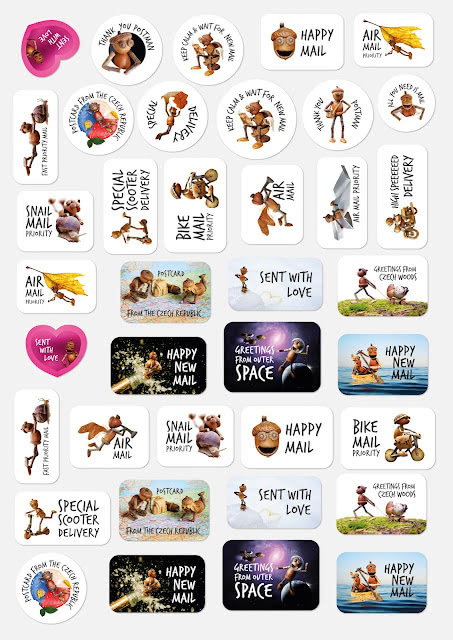
Petr paused from his work last autumn to share with Clarisse (aka CStar9) how he got his start in photography, give us an inside look at his artistic process, and let us peek at the cute stickers he debuted last year.

You’ve described the acorn elves (dubánci, in Czech) as a happy accident. When building woodland characters to entertain your children, you ran out of chestnuts and switched to using acorns. At what point did you realize this was an idea that could be widely – even globally – popular?

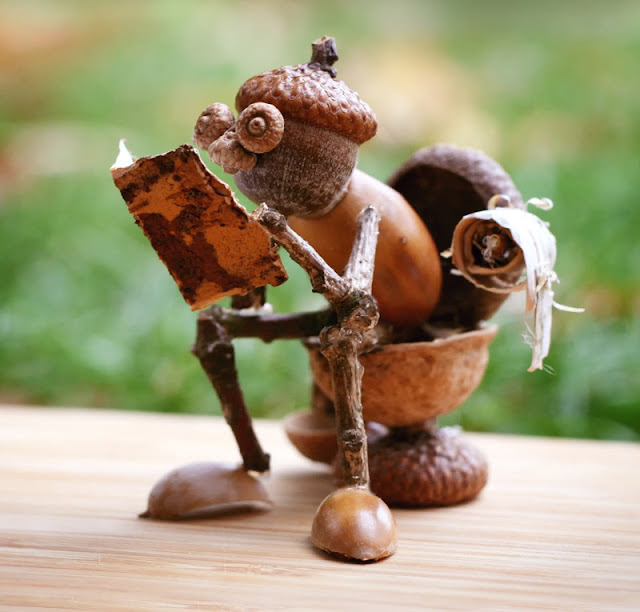
Yes, it was exactly like that – the acorn elves were created by accident. We ran out of chestnuts and so I used acorns instead, which we had plenty of in the garden. I first realised the popularity of the acorn elves when I posted the first pictures of them on social media – everyone loved them and they were one of my most successful posts. But it took me another year to realize how popular they really are. The first year I made only two or three figures, but a year later I made more and since then I’ve been making them regularly. The most successful one was of course the one sitting on the toilet, which literally went around the world (at least on the internet).

An acorn elf sitting on a toilet made of half a tree nut, reading a newspaper made of birch bark
The most famous and widely shared acorn elf
What are some elements that define Dubánci for you?

Playful, curious, mischievous, funny, mischievous again… They are forest creatures that have inhabited oak forests since time immemorial (sometimes you can see them in nature, but they are very shy and can hide themselves skillfully), but at the same time they are – at least some of them – very curious and so they watch what is happening in the human world and then try to imitate humans. But they don’t always get everything right and that’s how a lot of comical situations arise, which I like to capture in photographs.

How do you get an idea from your head to the final image? Which step in that process is generally the most challenging / time-intensive?
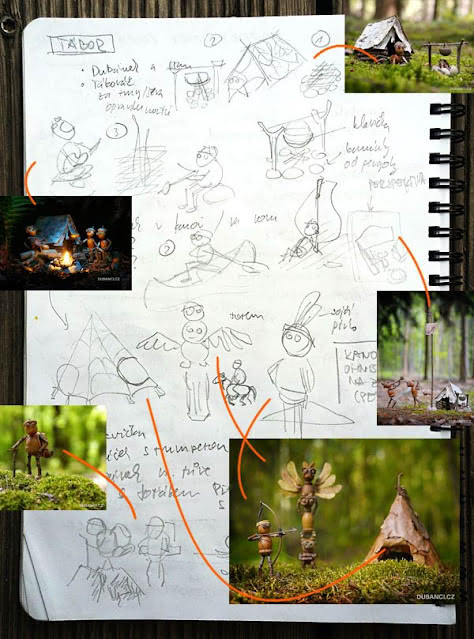
a mosaic of pencil sketches and photos of acorn elves
Learn more about Petr’s process behind one picture.

The process is sometimes a bit lengthy – sometimes it takes a few years from the initial idea, because I have a lot of ideas and they keep coming. In order to get them out of my head and not forget them, I write them down – actually, I sketch them – in a notebook, and then once in a while I make one of the ideas come true – I build an acorn elf based on the sketch, take it to the woods or some other nice place, take a photo of it there, and then edit the photos in Photoshop at home.

Sometimes the hardest part is to make the acorn elf, sometimes to glue together its equipment (bike, motorbike, lantern), and sometimes it’s much harder to take photos. Just to find a suitable place in the forest I have run dozens of kilometers there. Sometimes the shot needs a lot of editing in Photoshop, because even digital photography isn’t omnipotent (or I shot it wrong).

But I enjoy all of the above stages and am happy when the result entertains the fans.

Is there a particular image that has a funny or surprising creation story?

It’s interesting that even after eight years I still remember where I took each photo, including the story that led to the photo. Many of the photos were taken with my youngest daughter in the stroller – when she was about to go to bed after lunch, I loaded her into the stroller, grabbed my acorn elves and camera, and headed out into the woods. Along the way I looked for nice places to take pictures and when she finally fell asleep, I stopped and took pictures of acorn elves.

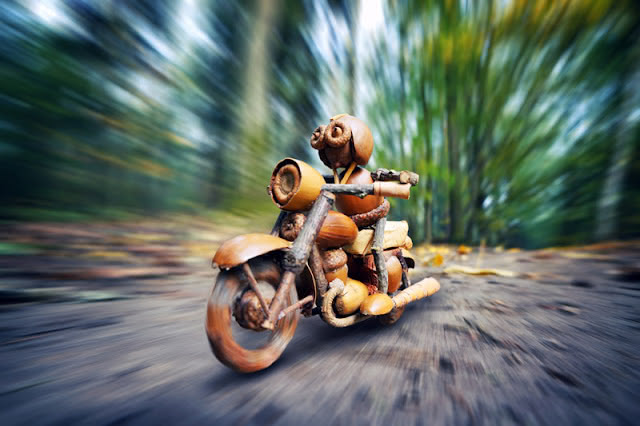
acorn elf on a motorcycle on a road with the forest seemingly whirring by
Faithful copy of the famous Czech motorcycle, the Jawa 250

I have made several means of transport for the acorn elves. The first one was a bicycle (I am an avid amateur cyclist), followed by a scooter, a skateboard and then a motorbike came to mind. But I wanted it to be perfect, so I found the plans of a historic Czech motorcycle, Jawa 250, and glued together a faithful copy of it. It’s probably their most challenging item – it took me 10 hours to glue it together, but the result is worth it!

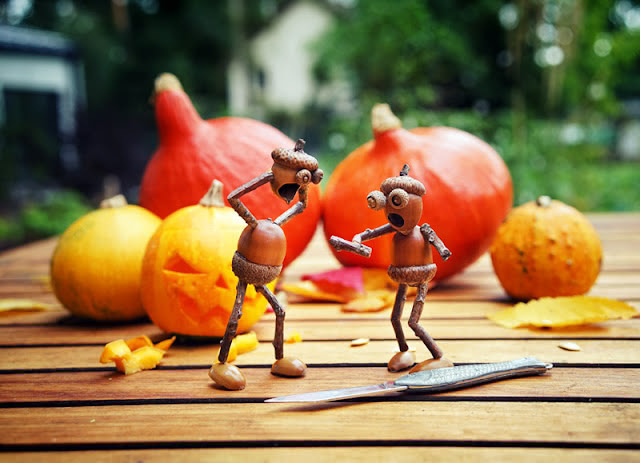
with little pumpkins in the background, two acorn elves stand on a table, one with its hand missing and one with its head off and a wooden pumpkin-carving knife in the foreground
A scene Petr didn’t plan!

While photographing the instructions for making Halloween pumpkin decorations for a children’s magazine, one of the acorn elves dropped his little hand. So I immediately shot a horror scene, which was definitely not in the plan. At least the kids will be more careful of their fingers when they are working with the knife while carving the pumpkins!

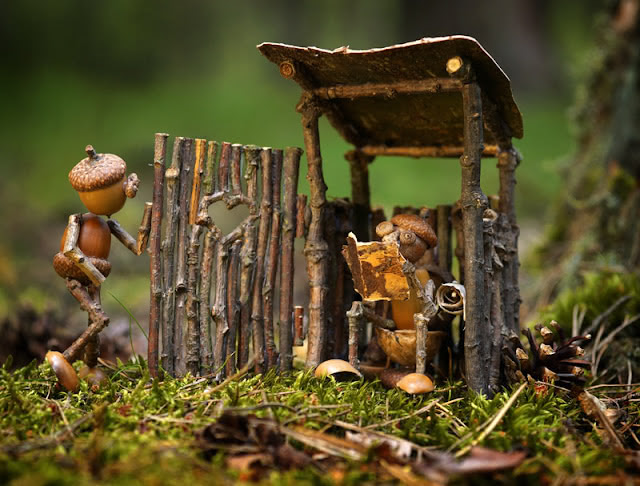
An acorn elf sitting in a portapotty made of sticks, with another acorn elf waiting its turn in queue

My most famous and favourite photo is of the acorn elf sitting on the toilet and reading newspapers. When I was taking a set of postcards for the holiday campers, I thought I would reuse the toilet! All I had to do was make a wooden caddy and a funny new scene was ready!

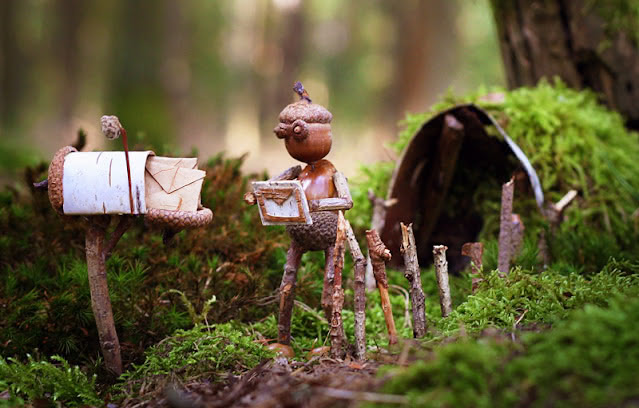
acorn elf pulling mail from a tiny birch bark mailbox
Petr’s first postcard of an acorn elf

This was one of the first acorn elves postcards. The owner of a local postcard company talked me into designing a couple of postcards with acorn elves on them. And when I told him that postcards weren’t used much anymore, he showed me Postcrossing. I was impressed and immediately asked him what should be on the postcard, what motif would users like the most. He replied – well, something with mail, like a mailbox. I immediately remembered that a few days ago I was building little houses for the acorn elves in the nearby forest with kids, so I just glued together a mailbox and some letters and postcards from birch bark at home and went to take pictures.

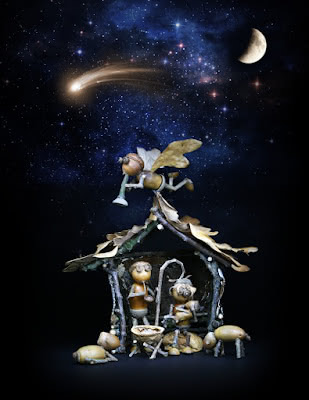
I was once approached by a magazine that said they would like to do an article on acorn elves and that they could be on the cover, but as it was for the Christmas issue they wanted something with a Christmas theme and came up with the nativity scene.

A nativity scene made from acorns, twigs, and leaves, set under a starry night sky with a crescent moon and a shooting star, featuring an angel flying above.

I took it as a challenge and had a great time. Especially shooting in the dark and lighting the scene. It made a perfect cover and to this day it is one of the most beautiful Christmas cards.

What is your studio like?

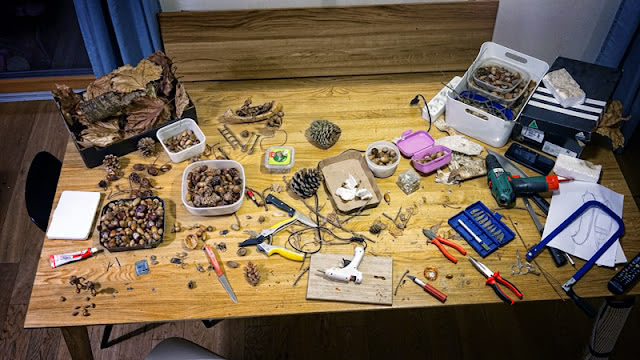
I may surprise you, but I don’t have a studio. I usually glue them in the evenings at home, right in the living room on the table, when my wife and children are asleep. I have a quiet place to work and no one disturbs me. It’s just that the midnight clean-up is sometimes more difficult, because I have to carry a lot of boxes of material and all sorts of tools while I’m working.

A crafting workspace with a wooden table covered in tools, glue, twigs, acorns, and natural materials, used for creating miniature figurines.
Petr’s studio: a table in the living room in the deep night

The most important tool in the work is of course the hot glue gun – it’s unbelievable what you can do with a melt gun. At one time I used to make stuffed animals with my youngest daughter with a melt gun because I got tired of sewing them with a needle :) Another must is a sharp knife or gardening shears. But sometimes you also need to use a jigsaw, a hacksaw, a small cutter or a soldering iron.

And if you ever catch me gluing acorn elves in the evening, you might be surprised how often I look in the mirror and try out their poses – I want the result to look as natural as possible. So sometimes I’ll use a mirror, other times I’ll search the internet for inspirational photos of the pose.

Acorn elves look simple. But there are trade skills needed to create their world: woodworking, photography, and design, to name a few. You learned woodworking in your father’s workshop as a child, then studied software engineering and became a programmer and web designer. When did photography come into your toolkit? And, do you still work as a designer?

When I was a kid, I liked to help my dad in the darkroom when he developed our family photos, but I didn’t try photography then. I didn’t get interested until after graduation, when I was a senior front-end developer for a multinational corporation and the first affordable digital cameras came out.

Sometime in 2003 I bought an Olympus C730 digital ultrazoom with an amazing 3 megapixel resolution and 10x optical zoom. It was a small miracle for me and I fell completely in love with digital photography – I watched a lot of photography websites, had my images critiqued and gradually learned how to take decent pictures.

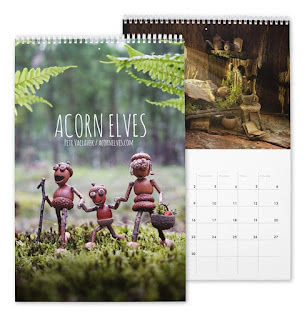
A calendar featuring Acorn Elves on the cover, depicting three handcrafted acorn figures walking in a forest, with a detailed interior photo showcasing a rustic scene.

Everyone liked my photos and I often heard that I could do it for a living. So I tried uploading my images to microstock sites and was surprised at how well they sold. So I gradually built up my portfolio on the microstock in the evenings, and later I started adding vector illustrations because I found they sold even more and I enjoyed making them.

As time went on, my earnings from the microstock were more than my income from my corporate job, so I switched to freelancing. Nowadays, I still make my living from the microstock, but I do other graphic design work on commission from time to time, and then of course the acorn elves make some money too, but I still think of them as my creative escapades that I do for fun.

What is your relationship to postal mail, and how has that evolved over time?

I love the mail, it’s always a surprise what turns up in the mailbox and when it arrives. When I discovered Postcrossing, I thought it was a great idea and I love it! My kids and I have sent several postcards out into the world this way. So I’m keeping my fingers crossed that the price of postage doesn’t go up too much and that Postcrossing will continue to thrive in the future.

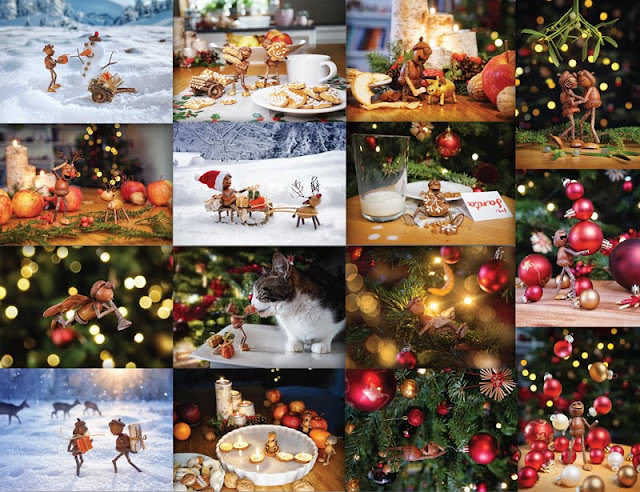
a selection of Christmas postcards

And one more thing – this year I have prepared a special set of stickers with acorn elves for decorating postcards. So maybe someone will like it.

A sheet of whimsical stickers featuring acorn figurines in playful poses with captions like Sent with Love, Snail Mail Priority and Happy New Mail.
Get the stickers here!
What’s something you’re proud of, outside of the acorn elves project?

Definitely my kids! We have three and they’re so smart. My oldest is following in my programming footsteps and my two daughters are incredibly creative, so I have my acorn elves followers.

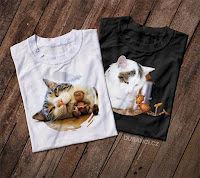
The acorn elves are now postcards, calendars, stickers, t-shirts, books, even games. What’s next for them, and for you?
Two t-shirts featuring a sleeping cat cuddling with acorn figurines, displayed on a wooden background.

I’ve been making postcards, calendars, and t-shirts for years. I thought it was a shame to keep the photos only on the internet. This way, the acorn elves are more exposed to the real world and many more people get to know them. Over time, in addition to my Czech e-shop, I started a shop on Zazzle, just to fulfill the wishes of my foreign fans. And of course I also made a separate site in English.

In the last few years, I’ve started to create more books. I began to collaborate with a successful children’s book writer Klara Smolíková and so gradually three books with stories of acorn elves for children were created. It’s a different job again, when I have to read the text and take pictures according to the story.

I didn’t limit the author in any way as to what is and isn’t possible in photography and so there were many challenges that I thought I couldn’t possibly overcome. For example, I photographed a flying bird nest with a lizard and an acorn elf, or an acorn elf with a dog fleeing underground through mole burrows from fighting earthworms. But in the end I did it all! And if I can get a publisher abroad, these lovely books will be published in English.

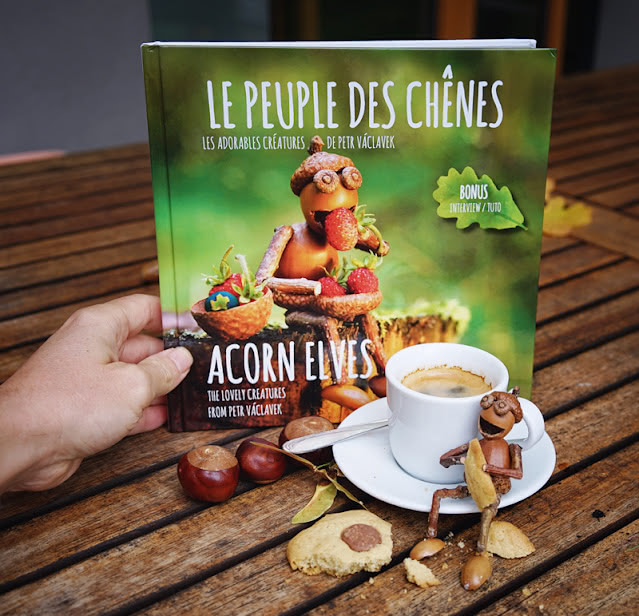
Actually, I have already published one book in France, bilingual (English and French): Acorn Elves – the lovely creatures from Petr Vaclavek. But it doesn’t contain a story for children; it’s a book of my photos with short bilingual captions, a short interview, and a photo guide for gluing and taking pictures of an acorn elf.an acorn sits on a plate eating a snack while a hand holds up the book about Acorn Elves

What does the future hold for the acorn elves?

I’d love to see them in an animated movie or TV show someday. I’ve been working with a Czech company on this for a year now, but it’s a long haul – you can’t do it with one person anymore. I definitely also want to try to come up with a board game with acorn elves in the next few years, and maybe we can make a computer game – that would be a nice stepping stone to a movie.

You can find out more about Petr and his acorn elves on his website, Facebook, Instagram, Youtube or other social media. You can also visit his shop for Europe or for the rest of the world.


And now, for the traditional giveaway! Clarisse is going to send 4 postcards featuring Petr’s Acorn Elves to 4 randomly picked postcrossers. To participate, you have to tell us: “If you could create your own acorn elf, what would it look like or what would it be doing?” Leave a comment below, and come back this time next week to check out the winners!

And the winners of this giveaway, as chosen by Paulo’s random number generator are… ChrStroh, wendyquilter, harrickson and Blumenkohl! Congratulations, and thank you all for participating!

183 comments Comments

  Posted on
A box set titled The Snooty Bookshop: Fifty Literary Postcards by Tom Gauld, designed to resemble a book with illustrated shelves and characters.

Tom Gauld is a Scottish cartoonist and illustrator. He is perhaps best known by postcrossers for The Snooty Bookshop: Fifty Literary Postcards, which celebrates more than a decade of his weekly cartoons in The Guardian.

Tom has authored many books—mostly books for grown-ups, but also one of Clarisse’s preschooler’s favorites. Tom’s newest book was recently nominated for what would be his second Eisner Award. But all the accolades haven’t made him too snooty to do an email interview with Clarisse (aka CStar9)! Phew!

Pretend you’re walking onto a metaphorical sports field as the star player for this interview. What psych-up music should we play?

I’ve only had to choose walk-on music once in my life, for a talk in Madrid at a fancy venue. I overthought it for weeks, swinging between cheesy and pretentious choices, but eventually I plumped for “Let’s Come to an Arrangement” by Martin Creed because it felt suitably upbeat and noisy in a funny, slightly weird way. Plus he is Scottish, like me.

What are some of the elements that define your work across your cartoons, graphic novels, children’s books, and more? In 5 words or less, what do you hope people take away?
A spread showing illustrations from The Little Wooden Robot and the Log Princess, depicting a workshop and a magical transformation scene.
Pages from The Little Wooden Robot and the Log Princess

I try to use the language of comics in new ways, while bringing in science, literature, lists, diagrams, games, and puzzles. I want my images to be clean and easy to read, but also to have a hand-made quality with a bit of wobble to the lines and hand-written text.

I don’t really have any kind of agenda or big plans to push. I just want to entertain the audience in a reasonably intelligent way and have them go away (in 5 words) “feeling a little bit happier.”

You’ve mentioned that your job is “to be silly about intelligent subjects.” Why books/literature, and why science?

The mercenary answer is that I get paid to draw on these subjects. The Guardian asked me to do weekly cartoons about books about 16 years ago. Then New Scientist hired me about 8 years ago to do science cartoons. But I don’t think they would have asked if there wasn’t something in my work already that suited the subjects. Certainly I couldn’t have made so many if I wasn’t interested in these subjects.

On some level, literature and science are both about trying to understand the world. There is enough in that (or in people failing to understand the world) to keep me going. Plus, new stories come up every week about advances in science or happenings in the literary world and these can inspire cartoons.

A comic panel with scientists in front of a blackboard discussing equations, a wormhole, and green poodles on the wall.
Comic from Gauld’s book, Department of Mind-Blowing Theories
You submit a weekly cartoon for both The Guardian and New Scientist. What do you do about creative block? Is there a strip you can point to and say, that was HARD WON?

Weekly deadlines really help me avoid creative block. I have no choice but to hand in something by a certain day, so in a way, that frees me from feeling it has to be perfect.

Some weeks I can’t come up with anything that feels really good to me, so I just have to take my least bad idea and make it work as well as possible. And sometimes (quite often actually) I realise later that the ‘least bad idea’ was actually a pretty good idea. I just was too tied up in the creation to be a good, objective judge of its merits.

I have a cartoon called “My Library” which is a diagram where books on shelves are colour-coded into categories like “read”, “intending to read”, “pretend I’ve read” and “read, but can’t remember a single thing about it”.

A colorful library illustration labeled My Library with books categorized by humorous statuses like read, half-read, and purely for show.
“My Library” cartoon, as described in the running text

I have a really clear memory of writing and rewriting those categories and feeling that it was a rather mediocre cartoon and saying to myself, “I’ll have to try extra hard next week to make up for this.” But then it was published and people related to it and found it really funny.

I’ve learned that as you rework a joke, you become overfamiliar with it and lose the initial unexpected spark of humour. But that spark will (hopefully) be there for the reader, so you’ve just got to trust that your past-self was onto something.

As for creative blocks on longer projects without weekly deadlines, which is something I struggle with: I don’t have an answer other than to just try to keep going.

A comic-style web popup warning about bawdy poems with a checkbox confirming age over sixteen in Shakespearean language.
What is your relationship to paper broadly, and specifically to postal mail? And, when can we expect your next postcard set?

I like making work that gets shared around. When I left college in 2001, we were still mainly promoting ourselves with printed stuff, so I made a few postcards to put in with orders for my mini-comics. People seemed to really like them, so I self-published a book of postcards called Robots, Monsters, etc. which outsold all my other self-published comics.

I’ve since made one other set of postcards myself. As you know, The Snooty Bookshop was properly published by Drawn & Quarterly. I’ll certainly do another at some point, but I have other projects queued up first.

Who would you say have been your main influencers? How does your work differ from theirs?

One big influence is Edward Gorey (who also did lots of postcards). I discovered his work in the library when I was studying at Edinburgh College of Art, and it just blew me away. He used the tools of comics and picture books in a unique and brilliant way. His work gave me permission to make comics without feeling I had to follow all the rules or fashions of the form.

I think I’m probably more interested in straightforward storytelling and jokes than Gorey was, but my drawing is definitely inspired by his, as is my interest in visual games.

A comic strip humorously depicting Wordle addiction with a conversation between a person and a therapist.
What’s a hobby you love, or a new skill you’re practicing, outside of your work?

My wife’s father has an old house in the countryside which has lots of old dry stone walls, some of which were falling down. Over the last few years, I’ve been putting them back together. It’s extremely satisfying. I’ve fixed all of them now, but there are a few bits I want to redo. It’s fun to do something with my hands where I don’t also have to think about what I’m saying.

A comic titled Baking with Kafka featuring Kafka’s existential reflections alongside a recipe for lemon drizzle cake.
Tell us about your studio.

Some years ago, I was in a big shared workspace with lots of other creative people, but the area gentrified and sadly the landlord put the rent up too much, so we all scattered. I’m now in a smaller place with two other artists. I worked at home a bit over covid but I prefer having a separate place to go to work, and some company when I’m there.

In the studio, I have a drawing desk, a computer desk, a “thinking” chair, and lots of books. The room upstairs is let to a musician, so we sometimes get piano music and singing drifting down, especially in summer when the windows are open. It’s very nice.

What’s next for you?

I want to make a new graphic novel. Writing my previous ones (Mooncop and Goliath) was probably the hardest thing I’ve done. I think my brain is more suited to short cartoons, but I love the form of the graphic novel so I keep trying.

A spread from Mooncop by Tom Gauld showing a lunar police station and an astronaut in a minimalistic sci-fi scene.
Pages from Mooncop

I’m continuing to make my two weekly cartoons, so work on other projects has to squeeze into the gaps and can be rather slow. But I’m excited about the possibilities of creating a longer story again.

You can explore more of Tom Gauld’s whimsical world on his website, Instagram, and Twitter. Dive into his weekly comic strips for The Guardian and New Scientist, or take a peek inside his studio to see where the magic happens. For aspiring cartoonists, Tom shares his journey and offers advice, while fans of his work can delve into the inspirations behind his beloved books, from the literary and scientific riffs in Revenge of the Librarians and Baking with Kafka to the heartwarming tales in his children’s book (which is SO GOOD!) The Little Wooden Robot and the Log Princess. And last but not least, don’t miss his reflections on crafting stories on the themes of nostalgia and isolation in his graphic novels Mooncop and Goliath.


And now, for the traditional giveaway! Clarisse is going to send 4 postcards from Tom’s Snooty Bookshop or from his (sadly sold out) new set of cards to 4 randomly picked postcrossers. To participate, you have to tell us one book or scientific discovery you’d recommend to an alien visiting Earth — what would it be? Leave a comment below, and come back this time next week to check out the winners!

And the winners of this giveaway, as chosen by Paulo’s random number generator are… Hafizaa, eselbox, Gummu and LulaandLittle! Congratulations, and thank you all for participating!

61 comments Comments