Postcrossing Blog

Stories about the Postcrossing community and the postal world

Viewing posts tagged "postal-history" View all

  Posted on

Most people know the name of Charles Lindbergh. He was a great American aviator, most famous for being the first pilot to complete a solo non-stop transatlantic flight, from New York to Paris, in May 1927.

But did you know that before his transatlantic adventures, Mr. Lindbergh was also a U.S. Air Mail pioneer (and later one of its advocates)?
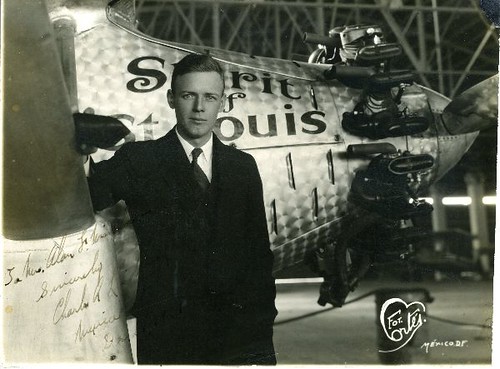
AC.Lind.C.007 Charles Lindbergh

As a child, Charles Lindbergh had always been interested in the mechanics of cars and motorbikes, and so it came as no surprise that when the time came, he chose to enrol in University as a mechanical engineering student. A couple of years later though, he found his true passion for aeronautics, dropped out and re-enrolled in a flying school in Nebraska. He spent a few years studying, doing air tricks & acrobatics across the country, testing planes and finally training with the American Army Air Service. At 23, he was a already veteran flier, but since the army didn’t need pilots at the time, he was looking for a job elsewhere…
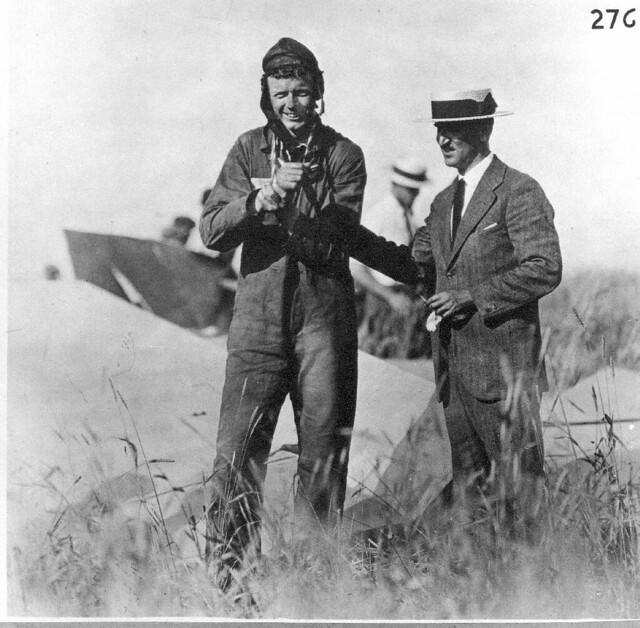
04-00525 Charles Lindbergh Delivers the Mail

Meanwhile, the US government had been running some experimental air mail routes between different cities for almost 8 years. The results were good, but the government had no intentions of continuing expanding the Air Mail Service on its own… and so in 1925, the Kelly Air Mail Act was passed by congress, which allowed the private sector to bid on specific airmail feeder routes to the main transcontinental system.
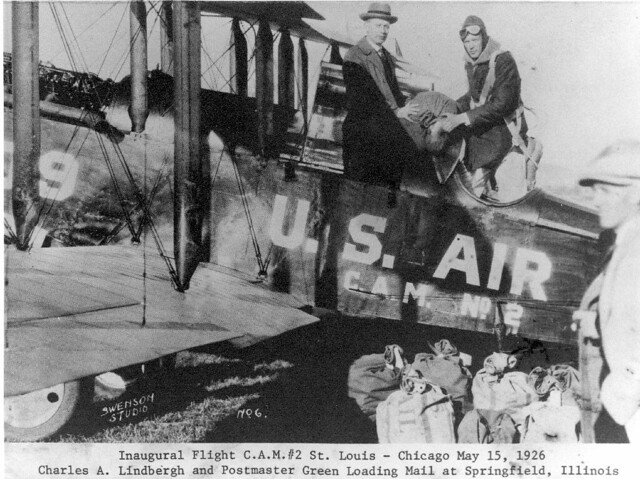
04-00524 Charles Lindbergh Delivers the Mail

And thus in October that year Charles Lindbergh was hired by the Robertson Aircraft Corporation to be the chief pilot on a Contract Air Mail route between St. Louis and Chicago, with 2 stops in Springfield and Peoria.
He started flying a modified war surplus de Havilland DH-4 biplane after swearing the Oath of Mail Messengers, which had to be changed to note him as a pilot instead of a mail messenger – you can see it here.

Lindbergh did well as an airmail pilot, achieving a remarkable 99% delivery efficiency even in the harsh conditions of the time (which included no proper equipment or landing facilities).
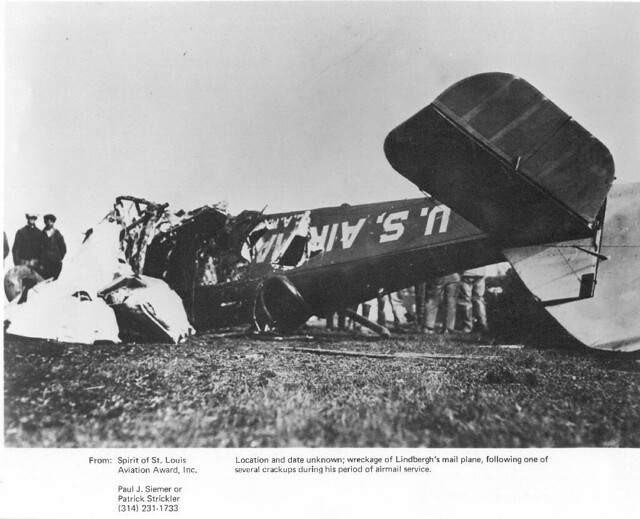
04-00518 Charles Lindbergh Air Mail Crash

Twice during his work he lost control of the plane due to bad weather or faulty equipment and had to jump out of it, landing by parachute on nearby fields. On both occasions, his first priority upon landing was to locate the wreckage of the planes and secure the mail – like a good mail carrier would!

He continued to be a chief pilot on this Air Mail route until February 1927, when he decided to take part on the race for the first non-stop flight from New York to Paris… Well, we all know how he did on that adventure! :)

Lindbergh, Charles

And although Charles Lindbergh never returned to the Air Mail career after winning the Orteig Prize, he kept on promoting the Air Mail services, by doing speeches on their behalf and carrying souvenir mail covers from international flights in his plane, the Spirit of St. Louis.

Credits: All photos by the San Diego Air and Space Museum Archives collection on Flickr. Read more about Charles Lindbergh on his wikipedia page and on charleslindbergh.com.

7 comments Comments

  Posted on

In the 1830s, the United Kingdom and the United States started carrying mail bags by train on their normal routes. Then, some years later, George B. Armstrong, assistant postmaster at Chicago, came up with the idea of sorting the mail on the train, while en route to its destination, to save time. The Railway Post Office (or RPO) was born!

Railway Post Office train carriage interior

A Railway Post Office looked like a normal train car on the outside, but had a unique interior design, with movable cast-iron fixtures that held the mail bags for sorting. These could also be folded if space was needed, as the train wagons tended to get very crowded! They also had their own cancellation stamps used only on board, and a special hook to snatch a bag of mail on the towns where the train didn’t stop. You can a demonstration of its use here.

Sorting the mail at a Railway Post Office

They became so widespread that in the 1880s, most passenger train routes in the US had their own Railway Post Office, allowing for a very efficient and speedy mail delivery. At the peak of their popularity in the 1940s, RPO’s were in use in over 9000 train routes, covering more than 200,000 route miles. In the next few decades though, the service would slowly decline and be replaced by airmail. The last Railway Post Office, which travelled between New York and Washington D.C., closed in 1977.

Snatching the mail at a Railway Post Office Railway Post officers working

Railway Post Offices now live in museums around the world, and on these beautiful pictures by the Smithsonian Institution on Flickr.

13 comments Comments

  Posted on

Do you know your mail carrier? How old are they? We bet not as old as Ted Ingram. Ted is 90 years old but he still delivers newspapers in Dorset, United Kingdom.

Ted has his job since since 1942 (imagine that!) and has delivered over 500,000 newspapers! That’s nearly 7 decades – we wonder how many people can claim to have hold any job so long!

The guinness book of records is now considering him as the oldest paperboy, but Ted says “I hope I can carry on the round when I’m 100, I have no plans to give it up”.

6 comments Comments

  Posted on

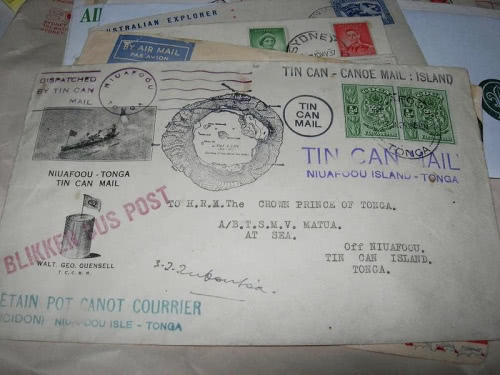
On the remote country of Tonga in the South Pacific, there’s a very special island. It’s name is Niuafo’ou, but it’s most commonly known as Tin Can Island for the way mail was delivered and sent for many years.

The concept of Tin Can Mail started in 1882 in this island when William Travers, a plantation manager, found himself without a way to receive mail from the rest of the world. The island had no harbour and was very steep so ships wouldn’t go there. So he came up with the idea that mail could be delivered inside of the ships biscuit tin cans that would be thrown overboard when they were passing by! He proposed this to the Tongan postal authorities and soon mail started to be delivered this way. But, don’t think this was an easy feat! With strong sea currents and distances of over a mile, this meant that to retrieve mail they could have to swim up to 6 hours!

Eventually the Tin Can Mail became extremely popular and also a tradition and soon ships started to come with passengers just to watch this incredible way of mail delivery. In 1928, Walter George Quensell produced rubber stamps saying “TIN CAN MAIL” that started being applied to all outgoing letters – over one million and a half, Quensell claimed.

Tin Can Mail

This method of mail delivered continued for over 100 years and it only ended in 1983 when a small airport was built in the island. Nonetheless, the Tin Can Mail history will live forever with special Niuafo’ou stamps – created by the Tonga postal services -, and on the hands of many collectors who are lucky enough to have a letter with the “TIN CAN MAIL” stamp.

Oh, and if you want to learn more about Tin Can Mail, be sure to check this page where you can find a lot more details about it.

11 comments Comments

  Posted on

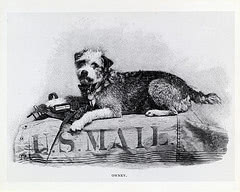
Have you heard of Owney the dog? This dog was a postal sensation during the late 1880s to the 1890s. Of course, he’s still popular today but not as popular as he did during the climax of his career.

One day in 1888, a stray dog wandered into a post office in Albany, New York. The postal workers took the dog in for the night and the poor, little fella fell asleep on a pile of sacks which were used to carry mail. During the next days, the postal workers decided to keep him and gave him his very own mail sack to sleep on.

Some accounts claim that Owney became so familiar with the scent and texture of the mail sacks that he followed one wherever it was taken. Another account says that Owney’s sack was needed one day and Owney followed its scent as it was brought into a postal train. Whatever the real story was, Owney’s career as the Post Office’s mascot was launched through his love of mail sacks.

Owney, the dogOwney would follow the mail sacks onto mail wagons, mail trains, and even mail steamships! Soon, the wonder dog was traveling all over the United States and the world!

In 1897, Owney died of a peaceful death. Through the various fundraisings performed by his friends and fans, his body was preserved and immortalized as an inspirational display – first at the Washington, D.C. headquarters of the United States Post Office (USPS) and then at the Smithsonian Institution.

If you’d like to see more of Owney, he’s quite popular on Flickr. There are a few postcards with Owney’s image on them and these can be new ideas for your next postcard mailing!

6 comments Comments